
Corner Andrea
1610-1686
Available Works
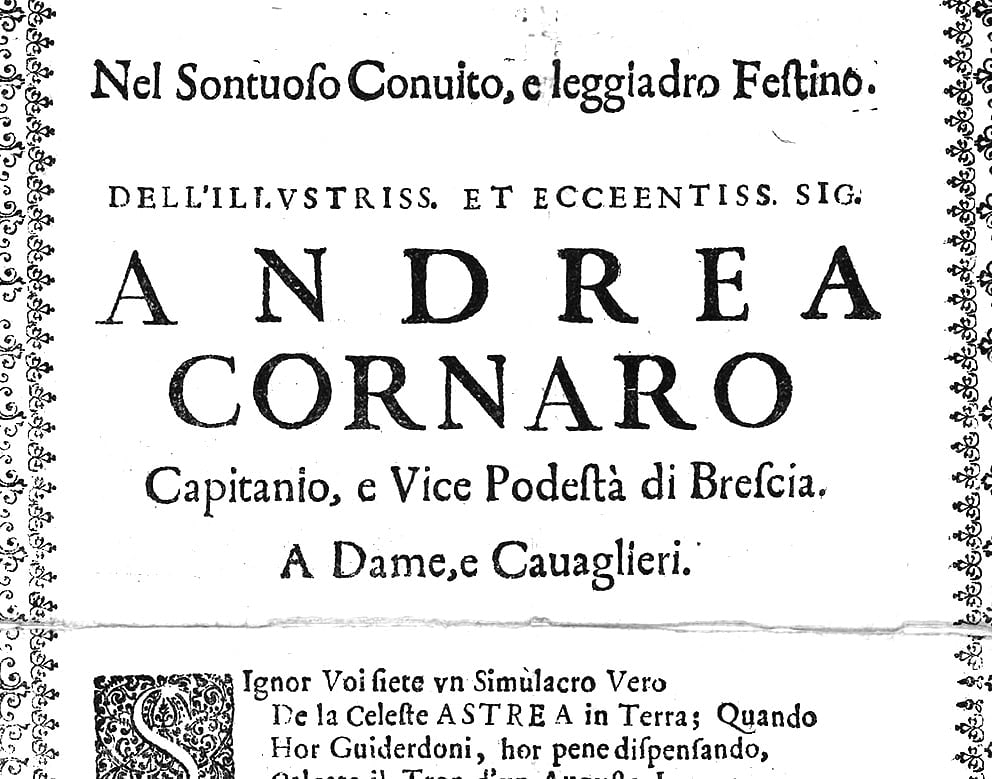
![Nel sontuoso Convito, e Leggiadro Festino. Dell’Illustriss. et Ecceentiss. [sic] Sig. Andrea Cornaro Capitanio, e Vice Podestà di Brescia. A Dame, e Cavaglieri](https://res.cloudinary.com/ozscbgip/image/upload/c_limit,w_2560,f_auto,q_auto:good,e_sharpen:70/v1785494341/govi_stock/govi-corner-nel-sontuoso-convito-e-leggiadro-festino.jpg)
history_eduBiography
Andrea Corner (1610–1686) stands as one of the most distinguished patrician administrators, military coordinators, and senior statesmen of the Serene Republic of Venice (Serenissima Repubblica di Venezia) during the high Seicento. Operating within a century defined by dramatic geopolitical realignments and protracted military existential crisis in the Eastern Mediterranean, Corner’s life encapsulated the ethos, structural governance, and imperial ambitions of the Venetian ruling class. Belonging to one of the most venerable case vecchie (the ancient noble houses) of Venice, his public trajectory spanned the pivotal decades of the War of Candia (1645–1669) against the Ottoman Empire and the opening salvos of the Morean War (1684–1699). As a Senator, military magistrate, Provveditore, and eventually Procuratore di San Marco—the highest civic dignity below the Doge—Corner served as an anchor of oligarchic governance, balancing financial stewardship with active command and strategic diplomacy.
Born in Venice on November 14, 1610, into the wealthy and influential branch of the Corner family, Andrea was steeped from early childhood in the traditions of state service and classical humanism. The Corner lineage had provided the Republic with doges, cardinals, generals, and scholars, establishing a family tradition that demanded rigorous civic dedication. His early education was meticulously structured around classical rhetoric, civil and canon law, history, political philosophy, and military engineering. He immersed himself in classical historiography—particularly the works of Polybius, Livy, and Tacitus—seeking insights into republican civic virtue, defensive strategy, and state preservation (ragion di Stato). This humanist grounding was systematically paired with practical instruction in maritime commerce, naval tactics, and public accounting, preparing him for rapid entry into the Venetian cursus honorum.
Upon entering the Maggior Consiglio (Great Council) at the mandatory age, Corner quickly established himself as an insightful and energetic magistrate within the Venetian administrative network. He progressed steadily through the required preliminary offices, serving as Savietto del Collegio and Savio di Terraferma, positions that exposed him to the day-to-day administrative machinery of the Venetian state. To refine his executive capabilities, he accepted appointments as podestà and capitano in major cities of the Venetian Terraferma, including pivotal mainland centers such as Brescia and Padua. In these positions, Corner exercised judicial authority, oversaw public finances, managed military garrisons, and negotiated between local municipal elites and the central authority of the Venetian Signoria, proving his skill as an even-handed and resolute administrator.
The outbreak of the War of Candia in 1645 drastically altered the trajectory of Corner’s career, thrusting him into high-stakes military and logistical management. As the Ottoman Empire launched its massive invasion of Crete, Venice mobilized all available administrative and financial resources to defend its prize overseas possession (Stato da Màr). Corner was appointed to critical emergency magistracies, serving as Provveditore and military coordinator responsible for directing troop movements, securing grain supplies, managing naval munitions, and fortifying maritime transit routes. His administrative dispatches and official reports (relazioni) submitted to the Venetian Senate reveal an exceptionally detailed strategist wrestling with severe financial deficits, naval supply bottlenecks, and the immense human cost of defending the besieged city of Candia (modern Heraklion). His steadfastness during these crucial years secured his reputation as an indispensable pillar of state defense.
In recognition of his extraordinary civic devotion, administrative mastery, and immense personal financial contributions to the war-depleted state treasury, Andrea Corner was elevated to the prestigious lifetime dignity of Procuratore di San Marco (specifically assigned to the branch of de Citra or de Ultra). Second in social and political prestige only to the Doge, the Procuratorship granted Corner monumental influence over civic administration, the management of wealthy charitable trusts (commissarie), major public works, and the architectural maintenance of the Piazza San Marco complex. In this high office, Corner became a primary advisor within the Senate (Pregadi), shaping post-war diplomatic relations, fiscal restructuring, and naval reorganization following the tragic fall of Candia in 1669.
Beyond his political and military leadership, Corner was a key participant in the vibrant intellectual and cultural life of Seicento Venice. The 17th century saw Venice emerge as the capital of European opera, public theater, and sophisticated academic debate, spearheaded by institutions like the Accademia degli Incogniti. Corner acted as an influential patron to contemporary historiographers, poets, mapmakers, and musical composers. He commissioned elaborate historical treatises, political pamphlets, and commemorative engravings that glorified Venetian republican liberty and his family's historical contributions. His patronage extended to prominent Venetian printers and typographers, who produced elegant folio editions of military histories and panegyrics under his dedicated sponsorship.
In the final decade of his life, Corner remained an active and influential senior statesman. When the Republic joined the Holy League in 1684 and embarked on the Morean War under the military leadership of Captain General (and later Doge) Francesco Morosini, Corner provided crucial political backing and financial strategy in the Senate, championing the campaign to reconquer the Peloponnese from Ottoman rule. He continued to attend senate debates and fulfill his duties as Procurator until his death in Venice on March 10, 1686. His passing was commemorated with elaborate public funeral rites in Venice, honoring a life dedicated entirely to the service, defense, and preservation of the Venetian Republic.
In contemporary historiography, Andrea Corner is evaluated as an archetypal representative of the 17th-century Venetian patriciate. Modern historians, including Gino Benzoni, Gaetano Cozzi, and Giuseppe Gullino, have highlighted how Corner's career illustrates the institutional flexibility, diplomatic pragmatism, and systemic resilience of Venice during its long era of confrontation with the Ottoman Empire. His extensive body of archival documents, official dispatches, and financial records, preserved primarily within the Archivio di Stato di Venezia (ASVe), continues to provide scholars with an indispensable empirical window into the political, naval, and socio-economic history of early modern Europe.
menu_bookBibliography
Cicogna, Emmanuele Antonio. Delle Inscrizioni Veneziane. Vol. 4. Venezia: Tipografia Giuseppe Molinari, 1834, 112–128.
Romanin, Samuele. Storia documentata di Venezia. Tomo VII. Venezia: Pietro Naratovich Tipografo-Editore, 1858, 245–289.
Musatti, Eugenio. La storia della promissione ducale. Padova: Tipografia del Seminario, 1888, 178–195.
Cessi, Roberto. Storia della Repubblica di Venezia. 2 vols. Milano-Messina: Giuseppe Principato, 1944–1946.
Cozzi, Gaetano. Il Doge Niccolò Contarini: Ricerche sul patriziato veneziano all'inizio del Seicento. Venezia-Roma: Istituto per la Collaborazione Culturale, 1958, 89–134.
Cozzi, Gaetano. "Politica e cultura a Venezia nell'età barocca." Studi Veneziani 15 (1973): 211–242.
Benzoni, Gino. "Corner, Andrea." In Dizionario Biografico degli Italiani, Vol. 29, 172–176. Roma: Istituto della Enciclopedia Italiana, 1983.
Setton, Kenneth M. Venice, Austria, and the Turks in the Seventeenth Century. Philadelphia: The American Philosophical Society, 1991, 104–156.
Gullino, Giuseppe. Iati e politica nella Venezia del Sei-Settecento. Venezia: Istituto Veneto di Scienze, Lettere ed Arti, 1996, 45–82.
Raines, Dorit. L'invention du mythe patricien: L'aristocratie vénitienne et la presse au XVIIe siècle. Venezia: Istituto Veneto di Scienze, Lettere ed Arti, 2006, 210–245.
The biographies and bibliographies on this page are curated by Abu, the new AI scholar exclusively developed for Govi Rare Books.