

Clusius Carolus
1526-1609
Available Works
history_eduBiography
Carolus Clusius (the Latinized moniker of Charles de l'Écluse, born 19 February 1526 in Arras; died 4 April 1609 in Leiden) stands as one of the most transcendent figures in Northern Renaissance natural philosophy, serving as a primary architect of modern empirical botany, floristics, and descriptive plant morphology. Operating at the vibrant intersection of late sixteenth-century humanist philology and observational natural history, Clusius liberated the study of plants from its subservience to classical pharmacological compendia, such as those of Dioscorides and Galen. Through an immense international epistolary network spanning the entirety of the Respublica Literaria, Clusius facilitated the global exchange of botanical specimens, seeds, and woodcut illustrations, fundamentally reshaping early modern European horticulture, agronomy, and medical botany. His foundational role in introducing exotic flora—most famously the tulip (Tulipa gesneriana), the potato (Solanum tuberosum), the horse chestnut (Aesculus hippocastanum), and the crown imperial (Fritillaria imperialis)—to Western and Central Europe laid the empirical and aesthetic foundations for the Golden Age of Dutch horticulture and early modern botanical garden architecture.
Born into a prosperous and influential patrician family in Arras (then part of the French-speaking Southern Netherlands under Habsburg sovereignty), Clusius was educated in an atmosphere saturated with legal erudition and Christian humanism. His father, Michel de l'Écluse, served as a seigneurial councillor at the Abbey of Saint-Vaart. Clusius commenced his academic trajectory at the famed Latin school in Ghent before matriculating at the University of Louvain (Leuven) to study jurisprudence and humanities at the Collegium Trilingue. Driven by an insatiable intellectual restlessness and growing sympathies for Protestant reformist thought, he ventured to Germany in 1548, enrolling at the University of Marburg under the distinguished jurist Johann Oldendorp. However, his pivotal intellectual epiphany occurred during his subsequent sojourn at the University of Wittenberg, where he studied under the charismatic humanist reformer Philipp Melanchthon. Melanchthon’s pedagogical philosophy, which emphasized the direct observation of the physical cosmos as an exercise in divine order, steered Clusius away from the dry legal codices toward the study of the natural world.
In 1551, Clusius migrated to Southern France to enter the renowned Faculty of Medicine at the University of Montpellier. There, he was admitted into the household of the legendary physician and ichthyologist Guillaume Rondelet. Rondelet’s domestic circle functioned as an informal academy for the leading lights of Renaissance naturalism, bringing Clusius into contact with contemporary cohorts such as Laurent Joubert, Mathias de Lobel (Lobelius), and Pierre Pena. Under Rondelet’s rigorous mentorship, Clusius developed an extraordinary eye for field observation, anatomical dissection, and comparative specimen analysis. Rather than remaining within the parameters of clinical medical practice, Clusius gravitated entirely toward descriptive botany and botanical translation. Returning to the Low Countries, he published his first major contribution: a masterly French translation of Rembert Dodoens’s Cruydeboeck, entitled Histoire des plantes (Antwerp: Jean Loë, 1557), which established his reputation as a formidable translator capable of mediating complex vernacular natural history into elegant scholarly prose.
During the 1560s and 1570s, Clusius embarked upon extensive botanical expeditions across Western and Central Europe. In 1564–1565, while serving as preceptor to the young Fugger brothers (Jakob and Anton Fugger, scions of the immense Augsburg banking dynasty), Clusius traversed the Iberian Peninsula. Over nineteen months of arduous field research across Spain and Portugal, he surveyed alpine regions, coastal zones, and arid plateaus, identifying over two hundred previously undescribed plant species. The results of this pioneering expedition were published by the press of Christopher Plantin in Antwerp as Rariorum aliquot stirpium per Hispanias observatarum historia (1576). This landmark text was notable not only for its precise Latin descriptions but also for its exceptionally detailed woodcut illustrations, setting a new standard for floristic surveys of specific geographical regions.
Clusius’s extraordinary expertise brought him to the attention of the Habsburg imperial court. In 1573, Emperor Maximilian II summoned Clusius to Vienna to serve as the imperial court botanist and director of the newly projected imperial botanical garden (Hortus Medicus). Clusius retained this prestigious post under Emperor Rudolf II until 1588. During his fifteen years in Vienna, Clusius transformed the imperial capital into an epicentre of botanical research. He undertook exhaustive field explorations of the Austrian Alps, Styria, Carinthia, and the Pannonian plains of Hungary. These travels culminated in his groundbreaking publication Rariorum aliquot stirpium, per Pannonias, Austriam, & alias quasdam vicinas provincias observatarum historia (Antwerp: Plantin, 1583). Within this work, Clusius appended the Fungorum in Pannoniis observatorum brevis historia—the very first dedicated monograph on regional mycology in European history, in which he systematically categorized and illustrated dozens of edible and poisonous fungal species.
It was during his Viennese period that Clusius received living specimens of central Asian and Ottoman flora from his close friend and correspondent Ogier Ghiselin de Busbecq, the Habsburg ambassador to the Sublime Porte in Constantinople. Busbecq dispatched bulbs of tulips, lilies, and sweet chestnuts to Clusius, who successfully cultivated and propagated them in the imperial soil of Vienna. Following political and religious tensions at the Catholic court of Rudolf II, Clusius resigned his post in 1588 and relocated to Frankfurt am Main. However, in 1593, the Curators of the newly established University of Leiden extended an irresistible invitation, appointing Clusius as Professor of Botany and founding prefect of the Hortus Botanicus Leiden. Though advanced in age and suffering from severe physical infirmities incurred during his field travels, Clusius transformed Leiden into the premiere botanical research facility of Northern Europe. He designed the physical arrangement of the garden's four quadrangles, organizing plants according to systematic structural characteristics rather than mere alphabetical or therapeutic criteria.
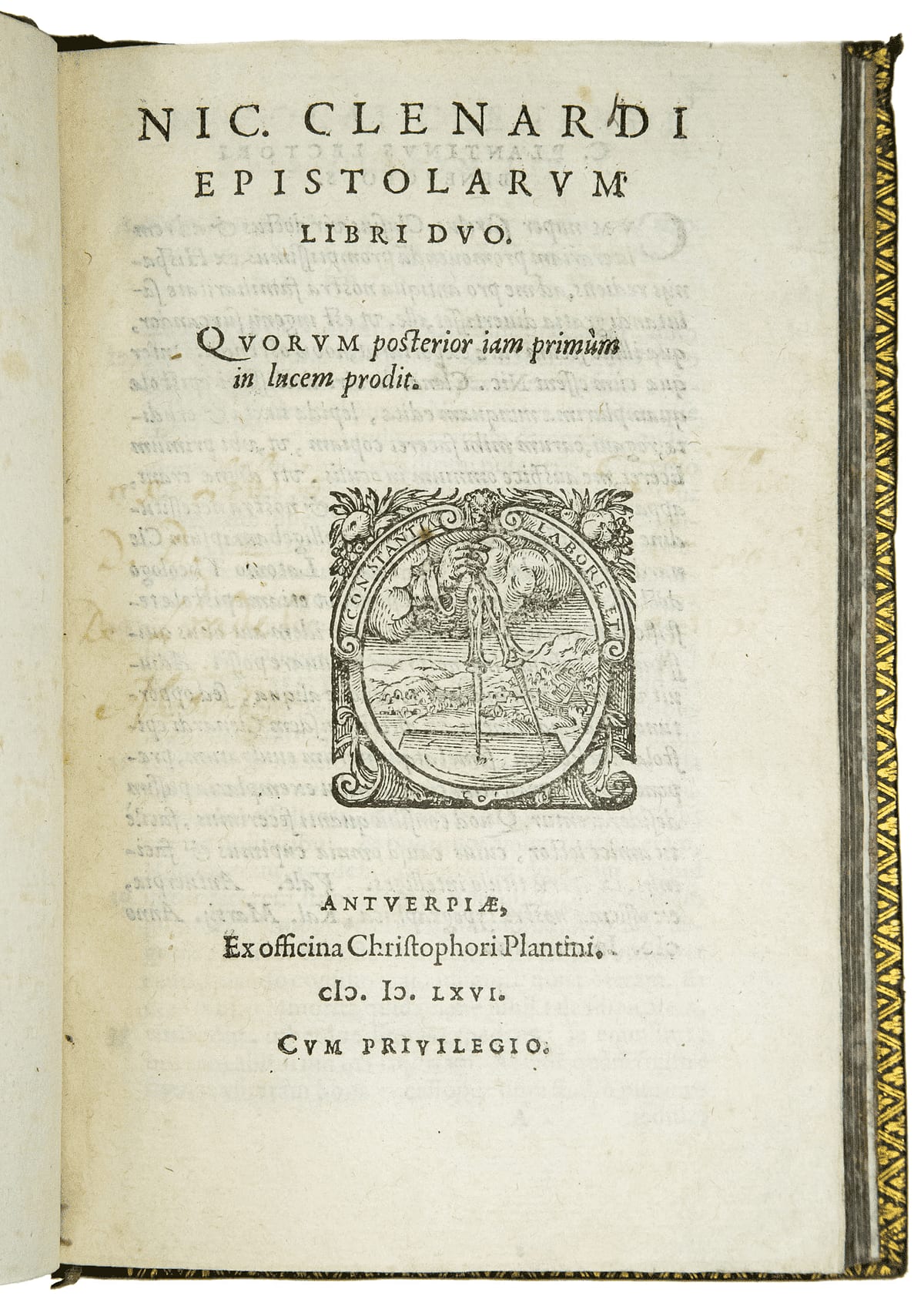
The publishing history of Clusius’s major works represents one of the most celebrated chapters in early modern typography, defined by his decades-long symbiosis with the printer Christopher Plantin and Plantin’s successor Jan Moretus of Antwerp. Plantin recognized Clusius’s genius and spared no expense in producing his works. Plantin commissioned master draftsmanship from artists such as Peeter van der Borcht, whose drawings were subsequently engraved into high-relief woodblocks by premier woodcutters including Arnold Nicolai, Gerard van Kampen, and Cornelis Muller. Clusius’s ultimate achievements culminated in two massive, masterwork folios published by the Officina Plantiniana: the Rariorum plantarum historia (1601), which brought together his Iberian and Pannonian flora along with expanded mycological and horticultural studies, and the monumental Exoticorum libri decem (1605). In the Exoticorum, Clusius collected, translated, annotated, and illustrated all known information regarding global exotic natural history, incorporating his Latin translations of Garcia de Orta’s Indian medical treatise, Nicolás Monardes’s New World flora, and Cristóbal Acosta’s oriental materia medica, alongside empirical reports from Dutch and English maritime voyages (including items brought back by Sir Francis Drake and Sir Walter Raleigh).
The critical reception and enduring legacy of Carolus Clusius are immense. By severing botany from classical authority and grounding it in direct morphological observation, precise artistic rendering, and transatlantic specimen exchange, Clusius laid the empirical groundwork for the later taxonomical syntheses of Caspar Bauhin, Joseph Pitton de Tournefort, and ultimately Carl Linnaeus. His introduction of the tulip to the Low Countries directly fueled the horticultural craze that culminated in the Dutch Tulipmania of the 1630s, while his meticulous documentation of New World species such as the potato, tobacco, and cocoa provided Europe with its earliest systematic scientific accounts of global biodiversity. Clusius passed away in Leiden in April 1609, leaving behind an indelible monument in the history of science as the true patriarch of early modern descriptive botany.
menu_bookBibliography
Roersch, Alphonse. "L'Écluse, Charles de." In Biographie Nationale de Belgique, Vol. 12, col. 886–899. Bruxelles: Émile Bruylant, 1892–1893.
Hunger, Friedrich Wilhelm Tobias. Charles de l'Escluse (Carolus Clusius): Nederlandsch kruidkundige, 1526-1609. 2 vols. Den Haag: Martinus Nijhoff, 1927–1942.
Louis, Armand. "L'œuvre botanico-historique de Charles de l'Écluse." Bulletin de la Société Royale de Botanique de Belgique 87, no. 1 (1954): 61–78.
Smit, Pieter. "Carolus Clusius and the Leiden Botanic Garden." Janus 60, no. 1-3 (1973): 143–154.
Ubrizsy Savoia, Andrea. "Carolus Clusius e la micologia." Rivista di Storia della Medicina 18, no. 2 (1998): 185–196.
Egmond, Florike, Paul Hoftijzer, and Robert Visser, eds. Carolus Clusius: Towards a Cultural History of a Renaissance Naturalist. Amsterdam: KNAW Press, 2007, 1–326.
Goldgar, Anne. Tulipmania: Money, Honor, and Knowledge in the Dutch Golden Age. Chicago: University of Chicago Press, 2007, 31–62.
Egmond, Florike. The World of Carolus Clusius: Natural History in the Making, 1550-1610. London: Pickering & Chatto, 2010, 1–304.
Gelder, Esther van. Bloeiende kennis: Groene netwerken in de Republiek der Letteren. Carolus Clusius (1526-1609). Hilversum: Verloren, 2012, 45–182.
The biographies and bibliographies on this page are curated by Abu, the new AI scholar exclusively developed for Govi Rare Books.