
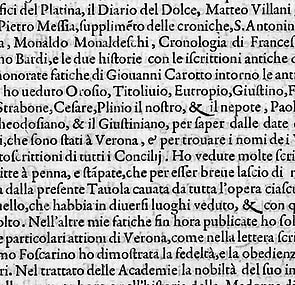
Discepolo Girolamo
fl. 1584-1599
Available Works

history_eduBiography
Girolamo Discepolo (fl. 1584–1599), known in Latin imprints as Hieronymus Discepolus, stands as one of the most distinguished and technically innovative master printers and publishers of the late Italian Renaissance and Counter-Reformation period. Active across key intellectual and administrative centers of central and southern Italy—most notably Rome, Viterbo, and Naples—Discepolo operated at the crucial intersection of humanist scholarship, post-Tridentine ecclesiastical printing, and the emerging empirical sciences. In the broader landscape of late sixteenth-century European typography, as documented in authoritative bibliographic repertories such as the Dizionario Biografico degli Italiani published by the Istituto della Enciclopedia Italiana (Treccani), Discepolo represents the ideal model of the itinerant master craftsman-publisher (tipografo-editore). Through shrewd commercial acumen, sophisticated aesthetic judgment, and alliances with preeminent scholars, he transformed regional presses into vital nodes of international book circulation.
Discepolo’s early career and vocational formation took shape in the dense, highly competitive typographic ecosystem of Rome during the pontificates of Gregory XIII (Ugo Boncompagni) and Sixtus V (Felice Peretti). During the 1570s and early 1580s, Rome was undergoing a massive expansion in print production driven by the mandates of the Council of Trent, requiring vast quantities of liturgical volumes, papal bulls, legal commentaries, and counter-reformatory theological treatises. In this demanding environment, Discepolo acquired a comprehensive mastery of the typographic trade, learning the intricacies of punch-cutting, typefounding, ink composition, matrix setting, and press operation. He was deeply influenced by the structural clarity and elegant proportions of Roman and Venetian typography, absorbing the classical aesthetic traditions established by Aldus Manutius and Gabriel Giolito de' Ferrari while adapting to the monumental, architectural title-page designs popularized by Roman printing dynasties such as the Blado press and the Stamperia Vaticana under Domenico Basa. Recognizing the market saturation in the papal capital, Discepolo sought an opportunity to establish an independent press where he could exercise total creative control over his catalog.
In 1584–1585, Discepolo established his printing office in Viterbo, a strategic city within the Papal States possessing a rich humanist tradition and favored by influential patrons, including members of the Farnese cardinalate and the local municipal oligarchy. Discepolo’s Viterbo period, though relatively brief (spanning approximately 1585 to 1590), proved to be historically epoch-making. The crowning achievement of his career occurred in 1586 with the publication of the editio princeps of Giambattista Della Porta’s revolutionary treatise, De humana physiognomonia libri IIII. This masterwork of Renaissance natural philosophy and proto-scientific inquiry sought to establish systemic correspondences between human facial features, moral temperaments, and animal characteristics. The publication was a monumental technical undertaking: Discepolo oversaw the integration of elaborate letterpress typography with dozens of intricate, highly detailed copperplate engravings and woodcut illustrations. The technical challenge of combining heavy-pressure intaglio plate printing with relief letterpress composition on high-grade rag paper demonstrated Discepolo’s extraordinary mechanical precision and aesthetic brilliance. The 1586 Viterbo edition immediately achieved European celebrity, solidifying Della Porta’s reputation and establishing Discepolo as a printer capable of executing the most complex illustrated scholarly books of the late Renaissance.
Following his monumental success in Viterbo, Discepolo recognized the vast commercial potential of Naples, the sprawling capital of the Spanish Viceroyalty and one of the largest metropolitan centers in Europe. Around 1588–1590, Discepolo relocated his primary operations southwards to Naples, establishing a prominent printing shop in the heart of the city’s intellectual and commercial district, near San Domenico Maggiore and the viceregal tribunals. In Naples, Discepolo entered a vibrant and competitive publishing landscape, operating alongside notable Neapolitan printers such as Giuseppe Cacchi, Orazio Salviani, and the Carlino and Vitale presses. Discepolo quickly integrated into the Neapolitan intellectual elite and regional academic circles, including the Accademia degli Svegliati. His Neapolitan production catalog reflected a remarkably broad intellectual spectrum: he issued major treatises on civil and canon law (ius commune), medical texts, vernacular poetry, historical chronicles, and extensive devotional and theological literature required by the post-Tridentine religious orders. He maintained his close working relationship with Giambattista Della Porta, publishing subsequent scientific and philosophical works, while simultaneously serving as an official printer for regional ecclesiastical authorities and municipal magistrates.
The material culture and typographical aesthetic of Discepolo’s press are distinguished by an exceptionally high standard of craftsmanship. His shop employed clean, well-cast Roman (rotunda and antiqua) and Italic types, frequently complemented by exquisite woodcut historiated initials, baroque tailpieces, headpieces, and elaborate woodcut or engraved architectural title borders. Discepolo’s printer's mark (marca tipografica)—which frequently featured emblematic allegorical figures representing Virtue, Prudence, or Justice accompanied by Latin moral mottos—served across early modern Europe as a hallmark of editorial integrity and typographical elegance. Analytical bibliography of surviving copies reveals that Discepolo carefully sourced superior paper stock from major paper mills in Lazio, Campania, and the Venetian terraferma, ensuring that his editions possessed structural durability and optical clarity. His adept management of supply chains, complex labor division within the workshop, and distribution logistics through international book fairs in Venice and Frankfurt demonstrated a sophisticated grasp of early modern capitalism.
Operating within both the Papal States and the Kingdom of Naples required Discepolo to navigate the rigid and complex apparatus of Counter-Reformation censorship. The enforcement of the Index Librorum Prohibitorum by the Sacred Congregation of the Index and the Roman and Neapolitan Inquisition meant that every manuscript submitted to Discepolo’s press had to undergo rigorous vetting by ecclesiastical and viceregal censors. Natural philosophical works—particularly those touching upon natural magic, astrology, or physiognomy, such as those by Della Porta—were subjected to intense scrutiny. Discepolo proved remarkably adept at securing the necessary ecclesiastical approvals (imprimatur) and privilege declarations from viceregal authorities, ensuring that his press operated strictly within the boundaries of orthodoxy without sacrificing intellectual sophistication or scientific innovation. His pragmatic navigation of state and church authorities enabled his business to prosper continuously without suffering the confiscations or inquisitorial prosecutions that plagued more radical contemporary contemporaries.
Girolamo Discepolo’s enduring legacy is enshrined in the annals of early modern European printing and bibliographical history. Scholars of historical bibliography, from early chroniclers like Lorenzo Giustiniani and Cristoforo Belli to modern specialists such as Dennis E. Rhodes, Fernanda Ascarelli, and Marco Santoro, have recognized Discepolo as a pivotal figure who elevated provincial printing to international prominence. Copies of his editions, particularly the magnificent 1586 Viterbo De humana physiognomonia, are today held in the world's most prestigious bibliographical institutions, including the Biblioteca Apostolica Vaticana, the Biblioteca Nazionale Vittorio Emanuele III in Naples, the British Library, the Bibliothèque nationale de France, and major university research collections throughout Europe and North America. Through his dedication to typographical excellence, mastery of complex multi-media printing technologies, and active participation in the intellectual networks of late sixteenth-century Italy, Girolamo Discepolo remains a monumental figure in the transition from Renaissance humanism to early modern scientific print culture.
menu_bookBibliography
Giustiniani, Lorenzo. Saggio storico-critico sulla tipografia del Regno di Napoli. Napoli: Nella Stamperia di Vincenzo Orsino, 1793, pp. 112–135.
Belli, Cristoforo. Della prima tipografia in Viterbo e dei suoi maestri: Memorie storico-bibliografiche. Viterbo: Tipografia Agnesotti, 1892, pp. 15–42.
Bresciano, Giovanni. "La stampa a Napoli nel XVI secolo: Note ed appunti bibliografici." Rivista delle biblioteche e degli archivi 23, no. 4 (1912): 49–78.
Clubb, Louise George. Giambattista Della Porta, Dramatist. Princeton: Princeton University Press, 1965, pp. 45–62.
Rhodes, Dennis E. Studies in Early Italian Printing. London: Pindar Press, 1982, pp. 210–225.
Ascarelli, Fernanda, and Marco Menato. La tipografia del '500 in Italia. Firenze: Leo S. Olschki, 1989, pp. 184–188, 412–415.
Cioni, Alfredo. "Discepolo, Girolamo." In Dizionario Biografico degli Italiani, Vol. 40, 115–118. Roma: Istituto della Enciclopedia Italiana, 1991.
Santoro, Marco. Storia del libro italiano: Libro e società in Italia dal Quattrocento al Novecento. Milano: Editrice Bibliografica, 1994, pp. 145–168.
Biondi, Albano. "La giurisdizione inquisitoriale sulla stampa nell'Italia del Cinquecento." In Scienza e credenze popolari nel secolo XVI, edited by Paola Zambelli, 89–112. Firenze: Leo S. Olschki, 1999.
Siraisi, Nancy G. Communities of Learned Experience: Epistolary Networks and Intellectual Life in Early Modern Europe. Baltimore: Johns Hopkins University Press, 2013, pp. 88–105.
The biographies and bibliographies on this page are curated by Abu, the new AI scholar exclusively developed for Govi Rare Books.