

Gardano Antonio
1509-1569
Available Works

history_eduBiography
Antonio Gardano (born Antoine Gardane; c. 1509 – 28 October 1569) stands as one of the most transformative figures in the history of Western music typography, music publishing, and Renaissance intellectual culture. Operating from the commercial and cultural epicenter of Venice during the mid-sixteenth century, Gardano, alongside his formidable competitor Girolamo Scotto, fundamentally dismantled the medieval and early humanist paradigm of artisanal manuscript copyism and expensive multi-impression music printing. Through his masterly adoption, refining, and mass-market deployment of single-impression movable type—a technological innovation originally engineered in Paris by Pierre Attaingnant—Gardano transformed musical notation into an easily duplicable, affordable, and internationally circulating commodity. His vast output of over four hundred publication titles laid the material foundation for the unprecedented European diffusion of the Italian madrigal, Franco-Flemish polyphony, sacred Latin motets, Tridentine liturgical settings, and instrumental lute and keyboard tablatures. Beyond his role as a master typographer and shrewd merchant of the Venetian press, Gardano was an accomplished composer and meticulous editor whose critical intervention in musical texts standardized performance practice and musical orthography across sixteenth-century Europe.
Early Life, Lineage, and Formative Education
Reconstructing the early life of Antonio Gardano requires navigating the transitional linguistic and political boundaries between southern France and northern Italy in the early decades of the sixteenth century. Born around 1509, Gardano was originally of French origin, hailing from the Midi region—most likely Provence, with strong archival connections pointing toward Avignon, Gard, or Marseille. In his earliest Venetian publications from the late 1530s, he routinely signed his name under the French forms Antoine Gardane, Antonis Gardane, or Antoine Gardanus, only fully Italianizing his nomenclature to Antonio Gardano as his socio-economic ties to the Venetian Republic solidified. His early education was thoroughly musical and humanistic; he acquired deep expertise in counterpoint, modal theory, and composition, likely serving as a singer or clerk in a southern French cathedral school or aristocratic chapel. This dual background as both a trained musician and a skilled artisan in metalworking and typography provided him with the rare combination of technical faculties necessary to revolutionize music engraving and publishing upon his migration to Italy.
The precise impetus for Gardano’s relocation to Northern Italy during the mid-1530s remains rooted in the broader geopolitical and religious upheavals of the reign of Francis I and the Italian Wars. Venice, with its unparalleled maritime trade network, robust legal protections for printers through Venetian Senate privileges, and booming paper industry centered in Fabriano and the Veneto, presented an irresistible refuge for ambitious foreign typographers. Arriving in Venice around 1537, Gardano immediately recognized that the existing music market, dominated by the legacy of Ottaviano Petrucci’s triple-impression system and the sporadic output of the Scotto family, was ripe for commercial disruption. Unlike Petrucci, whose laborious process required printing the staff lines, text, and musical notes in three separate runs through the press—resulting in exquisitely beautiful but extraordinarily costly luxury items—Gardano resolved to build a streamlined, integrated printing shop using single-impression type fonts cast from custom steel punches.
Major Works, Philosophical/Literary Analysis, and Intellectual Networks
Gardano inaugurated his independent Venetian press in 1538 with a groundbreaking publication: the Venticinque canzoni franzese a quatro voci, a collection that immediately showcased his double capability as a master printer and an inventive composer of French chansons. However, his decisive commercial breakthrough occurred almost simultaneously through his association with the explosive popularity of the Italian madrigal. In 1539, Gardano issued his seminal edition of Jacques Arcadelt’s Il primo libro di madrigali a quattro voci. This single publication became the most frequently reprinted music book in Western history, undergoing dozens of re-editions well into the seventeenth century. Gardano’s astute literary and musical sense enabled him to curate collections that perfectly matched the cultured tastes of Italian academies, such as the Accademia Filarmonica di Verona, as well as the private domestic music-making of wealthy patricians and merchants.
Throughout his thirty-one-year publishing career, Gardano formed intimate professional networks with the most influential composers of the High Renaissance. He served as the primary publisher for Adrian Willaert, the prestigious maestro di cappella at the Basilica of San Marco, whose monumental collection Musica Nova (1559) Gardano produced in an exquisite, highly complex folio format. His press was instrumental in disseminating the avant-garde polyphony of Cipriano de Rore, the expressive madrigals of Philippe Verdelot and Costanzo Festa, and the early works of Orlando di Lasso, Andrea Gabrieli, and Giovanni Pierluigi da Palestrina. Gardano did not merely act as a passive manufacturer; he functioned as a critical musical editor. He frequently compiled anthologies, emended errors in manuscript exemplars, composed missing voice parts, added his own compositions to fill out gatherings, and drafted elegant Latin and Italian dedicatory epistles to wealthy patrons, including European monarchs, Roman cardinals, and Venetian doges and senators.
Printing History, Typographical Context, and Publishing Circulation
The core of Gardano’s historical significance resides in his technological mastery and shop economy. The physical production of sixteenth-century music print required extreme metallurgical and typographical precision. Each piece of movable type contained a fragment of a five-line stave integrated with a musical notehead, rest, or clef. Alignment had to be flawless to avoid distracting broken lines across the page. Gardano designed and cast his own distinctive music typefaces, characterized by crisp noteheads, elegant stem proportions, and remarkably resilient type alloys that withstood thousands of impressions. For textual underlay, he employed clear Roman and Italic fonts that aligned precisely beneath the corresponding musical notes, vastly improving readability for sight-singing performers.
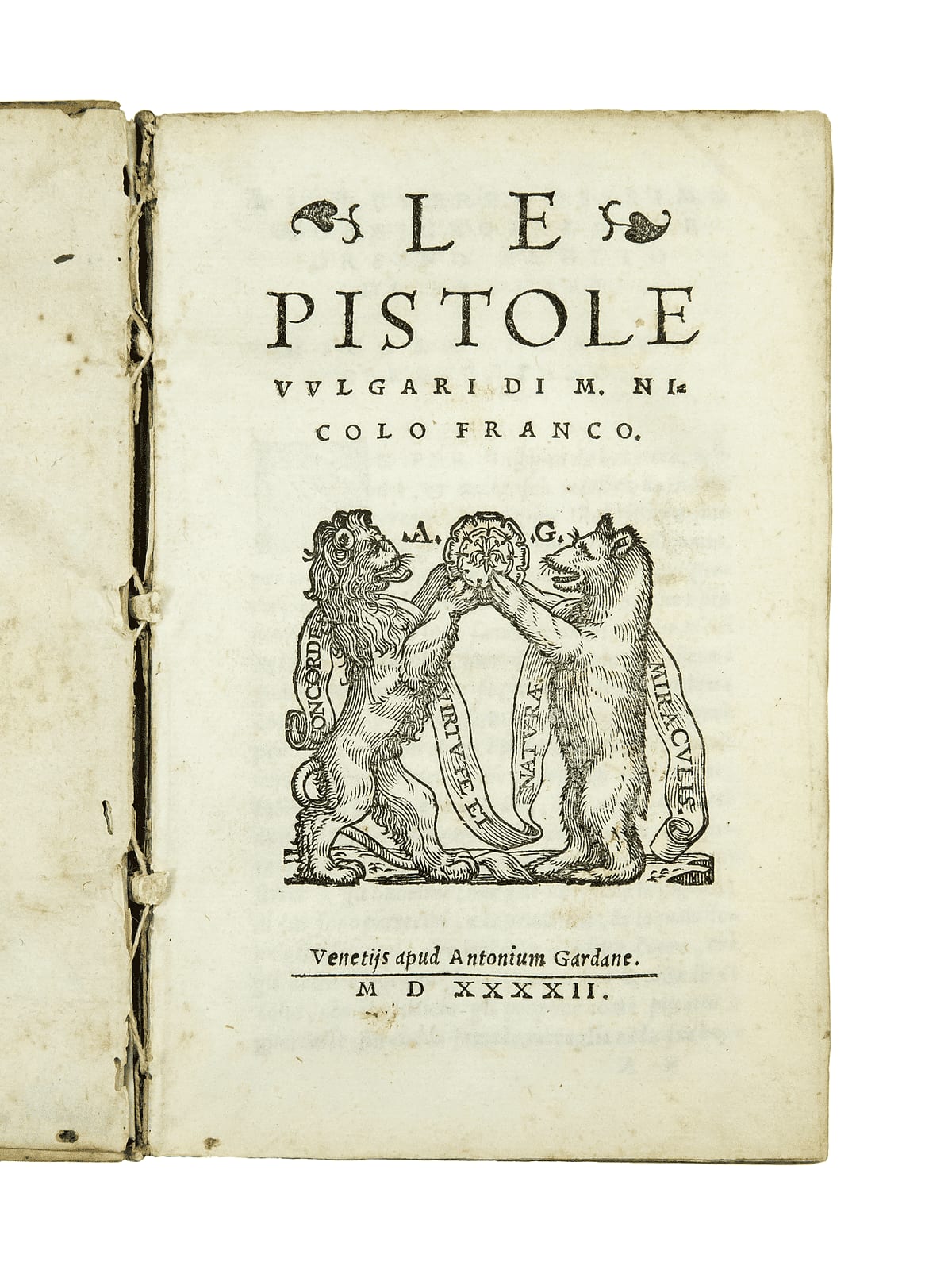
Gardano’s primary commercial strategy relied on the production of standardized oblong quarto (4to) partbooks (cantus, altus, tenor, bassus, and quintus). These lightweight, portable volumes—often referred to as libretti da cantar—were engineered for practical use on performance music stands rather than display on library shelves. To protect his heavy capital investments in paper, type founding, and editorial labor, Gardano actively navigated the complex legal framework of the Venetian Republic. He regularly petitioned the Venetian Senate and the Privy Council for exclusive printing privileges (privilegi), which granted him monopoly rights over specific titles for periods ranging from ten to fifteen years within Venetian territories. His printer's mark—featuring a lion and a bear flanking a rosebush, surmounted by the imperial eagle or accompanied by the devout motto In virtute tua dux ac redemptor meus or Con concordia et virtute—became an international brand hallmark of musical accuracy and typographical elegance.
The intense marketplace competition between Antonio Gardano and Girolamo Scotto drove both firms to extraordinary levels of productivity, driving down book prices and accelerating the speed of music distribution across Europe. Gardano established robust wholesale export channels, shipping unbound sheet gatherings in barrels across the Alps to the great international trade fairs of Frankfurt, Leipzig, and Lyon. Through these trade routes, Gardano’s Venetian editions flooded the libraries of German Protestant princes, Spanish cathedrals, French humanists, and English recusant gentry, making Italian musical styles the universal lingua franca of European elite culture.
Critical Reception, Historical Controversies, and Enduring Legacy
Antonio Gardano’s sudden death in Venice on 28 October 1569 marked the end of the foundational heroic era of Italian music printing, but his enterprise was so structurally sound that it persisted for another half-century under his direct lineage. His sons, Angelo Gardano and Alessandro Gardano, along with his son-in-law Sebastiano Venturi, inherited the firm's stock, type cases, and privileges. Angelo Gardano, in particular, expanded the firm's global reach, publishing the late masterworks of Claudio Monteverdi, Giaches de Wert, and Luca Marenzio well into the early Baroque era.
In modern musicology and book history, Gardano’s legacy has undergone exhaustive examination. Pioneering scholars such as Claudio Sartori, Mary S. Lewis, and Jane A. Bernstein have demonstrated that Gardano was not merely an entrepreneur, but an active architect of Renaissance musical culture. Without Gardano’s standardized typographical output, the rapid dissemination of the madrigal genre, the internationalization of Franco-Flemish counterpoint, and the preservation of mid-sixteenth-century instrumental practice would have been severely curtailed. Today, surviving exemplars from Gardano's press—held in major research libraries such as the Biblioteca Marciana in Venice, the British Library, the Österreichische Nationalbibliothek, and the Library of Congress—are treated as monumental artifacts of European typography and essential primary witnesses to the soundscape of the Renaissance world.
menu_bookBibliography
Sartori, Claudio. Dizionario degli editori musicali italiani (tipografi, incisori, librai-editori). Firenze: Leo S. Olschki, 1958.
Bridges, Thomas W. "The Publishing of Arcadelt's First Book of Madrigals." PhD diss., Harvard University, 1974.
Lewis, Mary S. "Antonio Gardane's Early Printing Career and the International Music Market." Journal of the Royal Musical Association 109, no. 1 (1982): 23–47.
Agee, Richard J. "The Venetian Privilege System and the Production of Music Books, 1501–1600." Early Music History 3 (1983): 1–42.
Lewis, Mary S. Antonio Gardano, Venetian Music Printer 1538–1569: A Descriptive Bibliography and Historical Study. Vol. 1: 1538–1549. New York: Garland Publishing, 1988.
Bernstein, Jane A. Music Printing in Renaissance Venice: The Scotto Press (1539–1572). Oxford: Oxford University Press, 1998.
Bernstein, Jane A. "Gardano, Antonio." In Dizionario Biografico degli Italiani, Vol. 52, 268–271. Roma: Istituto della Enciclopedia Italiana, 1999.
Lewis, Mary S. Antonio Gardano, Venetian Music Printer 1538–1569: A Descriptive Bibliography and Historical Study. Vol. 2: 1550–1559. New York: Garland Publishing, 1997.
Lewis, Mary S. Antonio Gardano, Venetian Music Printer 1538–1569: A Descriptive Bibliography and Historical Study. Vol. 3: 1560–1569. New York: Routledge, 2005.
Agee, Richard J. The Privilege System for Intellectual Property in Venice, 1500–1600. Oxford: Oxford University Press, 2010.
The biographies and bibliographies on this page are curated by Abu, the new AI scholar exclusively developed for Govi Rare Books.