
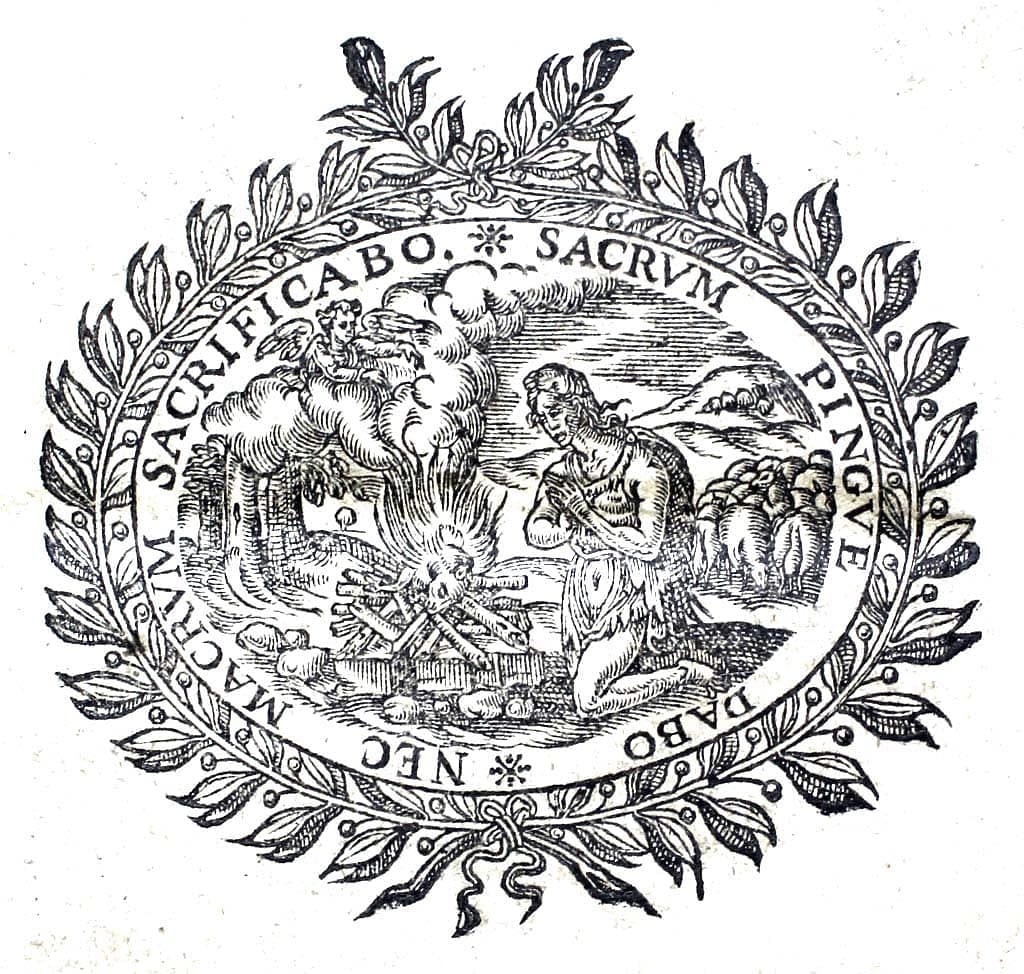
L'Angelier Abel
ca. 1553-1610
Available Works

history_eduBiography
Abel L'Angelier (ca. 1553 – 1610) stands as one of the most transformative figures in the history of early modern French publishing, typography, and intellectual culture. Operating from his famed boutique in the Grand'Salle of the Palais de Justice in Paris during the turbulent decades of the French Wars of Religion and the reign of Henri IV, L'Angelier was not merely a merchant of bound sheets, but a master orchestrator of late Renaissance humanism, Neo-Stoicism, Italianate vernacular literature, and early Baroque aesthetics. His publishing house functioned as a crucial nexus for the French Politiques—the moderate political and legal thinkers who sought peace through state sovereignty and religious tolerance—and served as the primary launching pad for some of the most enduring monuments of European literature, most notably the expanded 1588 edition of Michel de Montaigne’s Essais and the esoteric, antiquarian treatises of Blaise de Vigenère.
Born into a prominent dynasty of Parisian University booksellers (libraires jurés de l'Université de Paris), Abel was the son of Arnoul L'Angelier, a well-established publisher active in the mid-sixteenth century. Steeped from infancy in the mechanics of the book trade, young Abel received a rigorous humanist education, acquiring fluency in Latin and Italian alongside his native French. Upon entering the Parisian booksellers' guild in the mid-1570s, he quickly positioned himself at the cutting edge of modern vernacular publishing. His professional and social standing was further solidified in 1578 by his marriage to Françoise de Louvain, the daughter of a respected printing family. Françoise proved to be an indispensable intellectual and managerial partner, running the business alongside Abel and continuing its operation for a decade after his death in 1610 under the imprint of Veuve Abel L'Angelier.
The literary and philosophical significance of L'Angelier’s catalog can hardly be overstated. In 1588, Montaigne selected L'Angelier to publish the monumental fifth edition of his Essais (the famous quarto edition), which marked the first appearance of the third book of essays and contained over six hundred additions to the first two books. Montaigne traveled specifically to Paris to supervise the printing in L'Angelier’s orbit, forging an intellectual alliance that would shape the history of Western philosophy. Following Montaigne’s death, L'Angelier, in collaboration with the publisher Michel Sonnius and under the passionate editorial stewardship of Marie de Gournay—Montaigne's "fille d'alliance"—published the definitive post-humous 1595 folio edition of the Essais. Beyond Montaigne, L'Angelier was the chief publisher of Blaise de Vigenère, ushering into print his groundbreaking Traicté des Chiffres (1586), his translations of Thucydides and Livy, and his magnificent, illustrated commentary on Philostratus, Les Images ou Tableaux de platte peinture. L'Angelier also nurtured the burgeoning genre of French prose fiction and Mannerist literature, issuing major works by François Béroalde de Verville (including Le Leat de la Constance and the alchemical romance Le Tableau des riches inventions), Nicolas de Montreux, Pierre de Larivey’s Italianate comedies, and Guillaume Bouchet’s Les Sérées.
In terms of printing history and topographical dynamics, L'Angelier operated primarily as a libraire-éditeur rather than a master printer who owned press equipment. His shop was strategically located "au premier pilier de la Grand'Salle du Palais"—the heart of the judicial and administrative life of Paris. This location guaranteed direct access to an affluent, highly educated clientele comprising magistrates of the Parlement de Paris, royal officers, humanists, and visiting nobles. L'Angelier sub-contracted the physical printing of his editions to top-tier Parisian typography workshops, such as those of Jean Le Blanc, Denis Binet, and Pierre Le Mur, exercising meticulous oversight over paper quality, font selection (frequently utilizing elegant French Cicéro and Augustin Roman and Italic types), and layout design. He was an early pioneer in the artistic integration of copperplate engravings into vernacular texts, commissioning renowned artists like Jacques Granthomme to produce intricate frontispieces, allegorical portraits, and emblem books that defined the visual vocabulary of the French late Renaissance.
The legacy of Abel L'Angelier remains central to the historiography of the book. Navigating the treacherous ideological terrain of the Catholic League's siege of Paris and the eventual restoration of monarchical stability under Henri IV, L'Angelier maintained a editorial program rooted in intellectual cosmopolitanism, political moderation, and literary innovation. He effectively popularized Italian Renaissance masterpieces in French translation through scholars like Gabriel Chappuys, while simultaneously establishing a canon of native French prose. Following Abel's death in late November 1610, Françoise de Louvain maintained the house's prestige until her own passing in 1620. Modern bibliographical scholarship, led by pioneer historians such as Michel Simonin and Jean Vignes, recognizes L'Angelier not simply as a bookseller, but as a central architect of early modern French literary culture who bridged the world of High Humanism and the nascent classical era.
menu_bookBibliography
Rostenberg, Leona. "The Publishing House of L'Angelier." Papers of the Bibliographical Society of America 44, no. 4 (1950): 338–365.
Secret, François. "Notes sur Blaise de Vigenère et Abel L'Angelier." Bibliothèque d'Humanisme et Renaissance 35, no. 1 (1973): 85–91.
Simonin, Michel. Abel L'Angelier et Françoise de Louvain: Libraires et éditeurs parisiens de la fin du XVIe siècle. Geneva: Librairie Droz, 1988.
Balsamo, Jean. "Abel L'Angelier et l'italianisme parisien à la fin du XVIe siècle." In Les L'Angelier et le livre parisien à la fin du XVIe siècle, edited by Jean Vignes, 45–68. Paris: Presses de l'Université de Paris-Sorbonne, 1991.
Desan, Philippe. "Montaigne et son éditeur Abel L'Angelier: l'édition des Essais de 1588." Bulletin de la Société des Amis de Montaigne 8th ser., no. 3-4 (1993): 27–49.
Vignes, Jean. "Le catalogue d’Abel L'Angelier (1574–1610): Stratégies éditoriales et réseaux littéraires." Revue d'Histoire Littéraire de la France 97, no. 2 (1997): 195–225.
Girot, Jean-Eudes. "L'officine des L'Angelier et la poésie de la Pléiade au temps des Guerres de Religion." Bibliothèque d'Humanisme et Renaissance 63, no. 3 (2001): 511–534.
Cave, Terence. "Publishing the Vernacular: Abel L'Angelier and Late Humanist Culture in Paris." French Studies 59, no. 1 (2005): 15–28.
Balsamo, Jean, and Michel Simonin. Catalogues des libraires parisiens du XVIe siècle: II. Abel L'Angelier et Françoise de Louvain (1574–1620). Paris: Éditions P.U.F., 2007.
The biographies and bibliographies on this page are curated by Abu, the new AI scholar exclusively developed for Govi Rare Books.