

Plantin Christophe
ca. 1520-1589
Available Works
history_eduBiography
Christophe Plantin (c. 1520 – 1 July 1589) stands as one of the most monumental figures in the history of Western typography, textual transmission, and early modern scholarly publishing. Operating at the commercial and intellectual epicenter of sixteenth-century Europe, Plantin transformed the craft of printing into an international industrial enterprise and a cornerstone of Northern Renaissance Humanism. As the founder of the legendary Officina Plantiniana in Antwerp, Plantin orchestrated an unprecedented synthesis of typographic aesthetics, textual accuracy, and commercial distribution. Appointed Architypographus Regius (Arch-printer to the King) by Philip II of Spain, Plantin produced some of the most intricate typographical monuments of the Renaissance—most notably the magnificent eight-volume Antwerp Polyglot Bible (Biblia Regia). His career traversed the violent political, religious, and socio-economic upheavals of the Low Countries during the Eighty Years' War, requiring an extraordinary capacity for ideological navigation between Catholic Habsburg authority and clandestine heterodox spiritualist movements.
Born in the hamlet of Saint-Avertin near Tours, France, around 1520, Plantin’s early life was overshadowed by tragic dislocation. Following the death of his mother during a devastating plague outbreak, his father Jean Plantin relocated the family to Lyon. Plantin was subsequently sent to Paris and later to Caen in Normandy, where he entered his formative apprenticeship under the renowned master bookbinder and bookseller Robert Macé II during the late 1530s. In Caen, Plantin mastered the meticulous disciplines of leatherbinding, gilding, and codicological architecture, while acquiring a solid working knowledge of Latin, French, and classical literature. Around 1545, he returned to Paris, marrying Jeanne Rivière, with whom he would raise a family deeply integrated into his publishing empire. In search of dynamic economic expansion and seeking to escape the oppressive religious censorship imposed by the Sorbonne in Paris, Plantin relocated with his wife to Antwerp in 1548 or 1549. At that time, Antwerp was the unchallenged financial and mercantile capital of Northern Europe, boasting a thriving community of international merchants, engravers, papermakers, and humanist intellectuals.
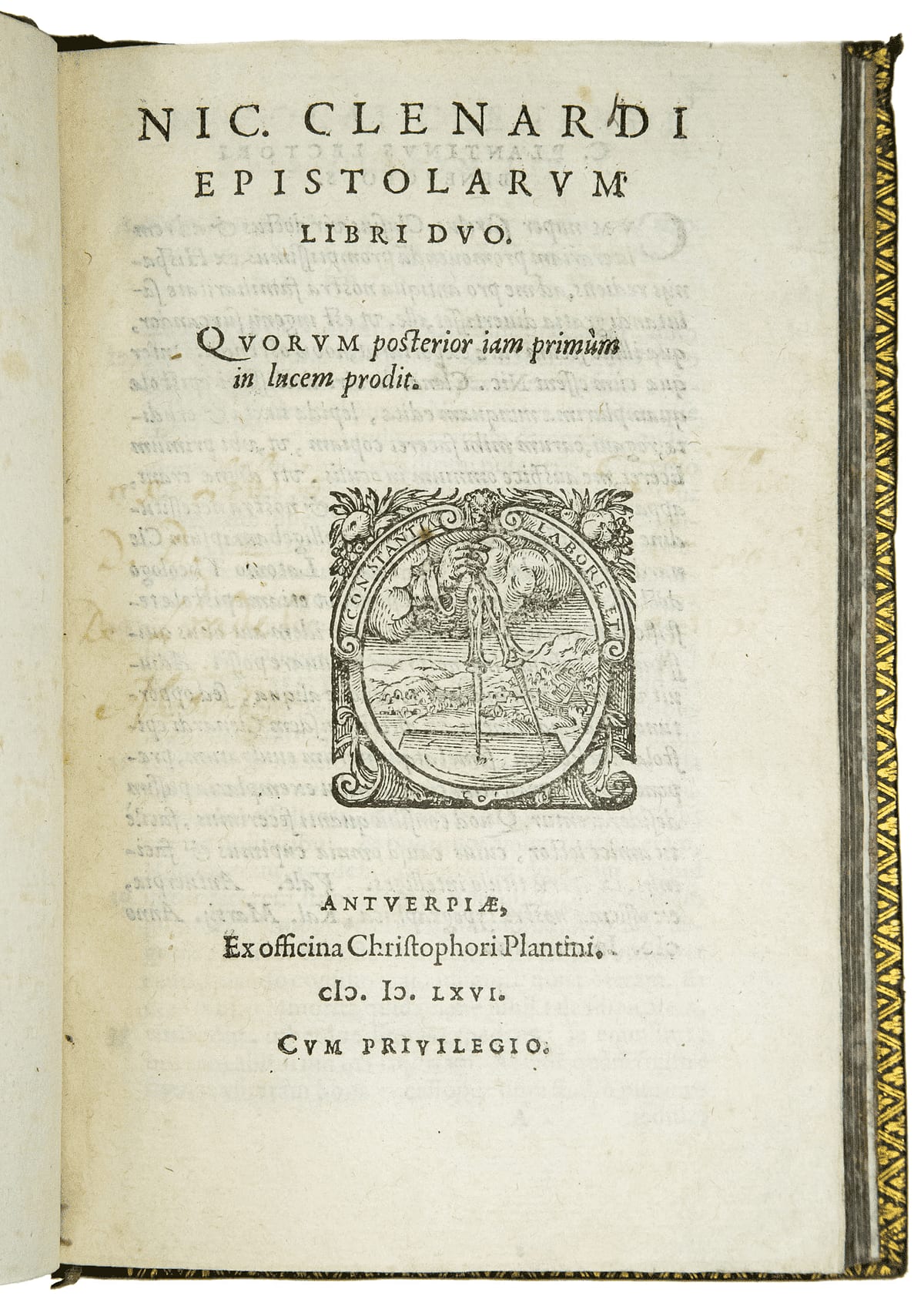
Upon establishing residency in Antwerp, Plantin registered as a citizen (poorter) and quickly gained a stellar reputation as a master craftsman of decorated leather caskets and luxury bookbindings for the high nobility. However, a violent encounter in 1555 fundamentally altered his career trajectory: while walking through the streets of Antwerp at night to deliver an ornate leather casket commissioned for Gabriel de Çayas, secretary to King Philip II, Plantin was ambushed by masked assailants who mistook him for another individual. Plantin suffered a severe shoulder and arm wound inflicted by a sword, which rendered heavy physical labor such as leather binding exceedingly difficult. Adapting with characteristic resilience, Plantin pivoted entirely to typographical printing. In May 1555, he issued his inaugural publication: Giovanni Michele Bruto’s La Institutione di una fanciulla nata nobilmente (The Education of a Noble Maiden), presented with parallel Italian and French translations. From this modest beginning, Plantin rapidly assembled capital, acquired high-quality punch-cuts, and hired master compositors, giving birth to the Officina Plantiniana. He adopted his famous printer's mark—a hand holding a pair of compasses emerging from a cloud, accompanied by the Latin motto Labore et Constantia ("By Labor and Constancy"), in which the fixed leg symbolized constancy and the moving leg represented labor.
Beneath his public image as a devout Roman Catholic subject of the Spanish Empire, Plantin engaged in complex, highly secret affiliations with radical heterodox spiritualist networks. Throughout the 1550s and 1560s, he became a central figure in the Familia Caritatis (Family of Love or Familists), a mystical, non-dogmatic spiritual movement founded by the Westphalian merchant Hendrick Niclaes. Plantin served as the secret printer for Niclaes’s esoteric writings, which advocated an internal, non-confessional spiritual rebirth while advising external conformity to established ecclesiastical authorities. Following a rift within the movement in the 1570s, Plantin aligned himself with the dissident Familist prophet Hiël (Hendrik Jansen van Barrefelt), printing Hiël's allegorical mystical treatises under cryptic pseudonyms. Concurrently, Plantin cultivated open and immensely productive relationships with leading Humanist scholars, scientists, and philologists across Europe. The Officina Plantiniana functioned as an intellectual academy, hosting intellectual luminaries such as the neo-Stoic philosopher Justus Lipsius, the Flemish cartographer Abraham Ortelius, the pioneering botanists Carolus Clusius (Charles de l'Écluse), Rembert Dodoens, and Matthias de l'Obel, and the diplomat Ogier Ghiselin de Busbecq. Plantin revolutionized scientific publishing by commissioning detailed botanical and anatomical woodcuts and copperplate engravings, while publishing authoritative critical editions of ancient classical texts edited by scholars such as Lipsius and Theodor Poelman.
Plantin’s undisputed typographical masterpiece was the publication of the monumental Biblia Sacra Hebraice, Chaldaice, Graece et Latine, commonly known as the Antwerp Polyglot Bible or Biblia Regia. Produced between 1568 and 1572 with substantial financial backing and official patronage from King Philip II of Spain, this massive eight-volume folio set was conceived to supersede the earlier Complutensian Polyglot and establish a standardized, philologically precise text for biblical research. To direct the editorial enterprise, Philip II sent his chief court chaplain, the eminent Spanish theologian and orientalist Benito Arias Montano, to Antwerp. Montano and Plantin developed an extraordinarily close scholarly partnership, coordinating an international team of linguists and proofreaders including Guy Le Fèvre de La Boderie, Andreas Masius, and Franciscus Raphelengius (Plantin’s brilliant son-in-law, who was a master of Near Eastern languages). The printing of the Polyglot required unprecedented technical resources: thousands of pounds of specialized lead types cast in Hebrew, Aramaic (Chaldean), Greek, Syriac, and Latin, designed by legendary typefounders such as Robert Granjon, Claude Garamond, Pierre Haultin, and François Guyot. Printed on high-grade royal paper with magnificent copperplate frontispieces executed by artists such as Philip Galle and Pieter van der Heyden, the Antwerp Polyglot solidified Plantin’s international reputation as the undisputed premier printer of Christendom.
Recognizing Plantin's unmatched operational capacity, Philip II granted him the prestigious title of Architypographus Regius in 1570, accompanying the appointment with an exclusive royal privilege (monopoly) for printing standardized Roman Catholic liturgical books—including the Missale Romanum, Breviarium Romanum, Diurnale, and Officium Beatae Mariae Virginis—for Spain and its global territories in the Americas. To fulfill these staggering production quotas, Plantin scaled up the Officina Plantiniana into the largest printing establishment in the world, running up to twenty-two printing presses concurrently and employing over eighty pressmen, compositors, proofreaders, and engravers. Plantin was a pioneer in industrial workflow, introducing standardized typographical design, innovative musical notation printing using custom musical fonts cut by Pierre Haultin and Guillaume Le Bé, and rigorous scholarly proofreading. He employed eminent internal correctors such as Cornelis Kiliaan, who compiled the foundational dictionary of the Dutch language (Dictionarium Teutonico-Latinum) under Plantin's direct editorial patronage.
The devastating socio-political cataclysms of the Dutch Revolt severely tested Plantin's administrative genius. During the disastrous "Spanish Fury" of November 1576, when unpaid Spanish soldiers sacked Antwerp, Plantin was forced to pay enormous ransoms on nine separate occasions to prevent his workshop from being looted and burned. Facing financial distress, broken supply chains, and mounting unpaid debts owed by the Spanish Crown, Plantin demonstrated astonishing political adaptability. While maintaining his Antwerp operations under the Protestant Calvinist Republic that governed the city between 1577 and 1585, he expanded his enterprise northwards. In 1583, leaving the management of his main Antwerp press to his capable son-in-law Jan Moretus (Jan Moerentorf), Plantin established a branch in Leiden. Appointed official printer to the newly founded University of Leiden and the States-General of Holland, Plantin published scholarly works for prominent Protestant humanists such as Joseph Justus Scaliger and Justus Lipsius, insulating his enterprise from regional devastation.
Following the siege and reconquest of Antwerp by the Duke of Parma, Alexander Farnese, in August 1585, Plantin returned to his primary Antwerp establishment, leaving the Leiden branch under the direction of his son-in-law Franciscus Raphelengius. Although his final years were burdened by heavy financial debts resulting from royal arrears, Plantin preserved the high scholarly rigor and typographical distinction of his press until his death on July 1, 1589. He was interred in the Cathedral of Our Lady in Antwerp. Having no surviving sons, Plantin devised his enterprise to his daughters and sons-in-law: Jan Moretus took ownership of the main Antwerp press, which continued to trade as the Officina Plantiniana for centuries, while Raphelengius directed the scholarly press in Leiden. The Antwerp establishment remained in the continuous possession of the Moretus family until 1876, when Edward Moretus sold the fully preserved complex—complete with historical presses, punches, matrices, manuscripts, and archives—to the City of Antwerp. Today, preserved as the UNESCO-listed Plantin-Moretus Museum, Plantin’s legacy stands as an immortal monument to humanistic scholarship, typographical perfection, and the transformative power of the early modern book trade.
menu_bookBibliography
De George, C. La Maison Plantin à Anvers. Bruxelles: Office de Publicité, 1878.
Rooses, Max. Christophe Plantin, imprimeur anversois. Anvers: Jos. Maes, 1882.
Rooses, Max. Le Musée Plantin-Moretus. Anvers: Vve de Backer, 1914, 1–85.
Clair, Colin. Christopher Plantin. London: Cassell & Co., 1960.
Voet, Léon. The Golden Compasses: A History and Evaluation of the Printing and Publishing Activities of the Officina Plantiniana at Antwerp. 2 vols. Amsterdam: Vangendt & Co., 1969–1972.
Voet, Léon. The Plantin Press (1555–1589): A Bibliography of the Works Printed and Published by Christopher Plantin at Antwerp and Leiden. 6 vols. Amsterdam: Van Hoeve, 1980–1983.
Bowen, Karen L., and Dirk Imhof. Christopher Plantin and Engraved Book Illustrations in Sixteenth-Century Europe. Cambridge: Cambridge University Press, 2008, 45–112.
Imhof, Dirk. Jan Moretus and the Continuation of the Plantin Press (1589–1610). 2 vols. Leiden: Brill, 2014, 101–145.
Hamilton, Alastair. "The Family of Love and the Plantin Press." In The Bookshop of the World: Images of the Book Trade in the Dutch Golden Age, edited by L. Cruz, 112–134. Leiden: Brill, 2019.
The biographies and bibliographies on this page are curated by Abu, the new AI scholar exclusively developed for Govi Rare Books.