
Taillepied Noël
ca. 1540-1589
Available Works
history_eduBiography
Noël Taillepied (c. 1540 – 1589) stands as one of the most intellectually versatile, if polemically charged, Franciscan authors of the late French Renaissance. A Doctor of Sacred Theology, Minorite friar (Cordelier), local historian, and pioneering pneumatologist, Taillepied operated at the turbulent confluence of late humanist erudition, urban chorography, and violent Counter-Reformation confessional conflict. Writing during the climax of the French Wars of Religion (1562–1598) and the ascendancy of the Catholic League (Sainte Ligue), his published corpus reflects a deliberate effort to deploy both classical antiquity and supernatural phenomenology in defense of Roman Catholic orthodoxy against the rising tide of Calvinist theology.
Born in or near Pontoise in Normandy around 1540, Taillepied entered the Order of Friars Minor in his youth, receiving an intensive education in scholastic theology and classical humanities. He pursued advanced university studies in Paris and Angers, eventually obtaining his doctorate in theology and assuming academic positions as a lecturer in theology within the Franciscan convents of Angers and Rouen. Taillepied’s intellectual formation was deeply shaped by the scholastic traditions of Duns Scotus and Bonaventure, yet he was equally responsive to the humanist return to primary classical sources. His mastery of Latin, combined with a vigorous command of the French vernacular, allowed him to bridge the gap between academic disputation and public apologetics at a moment when print culture was becoming the primary battleground of religious ideology.
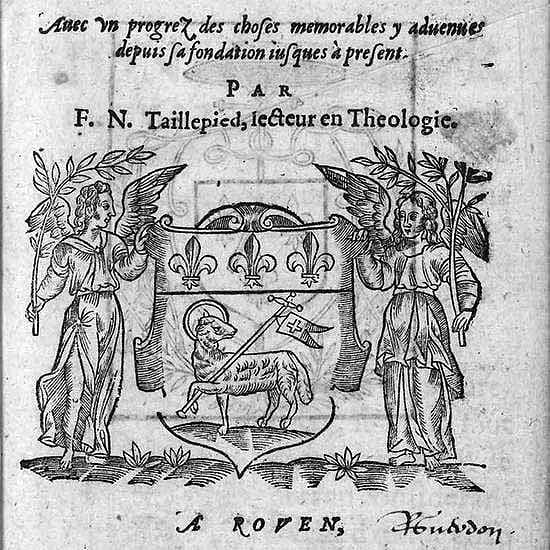
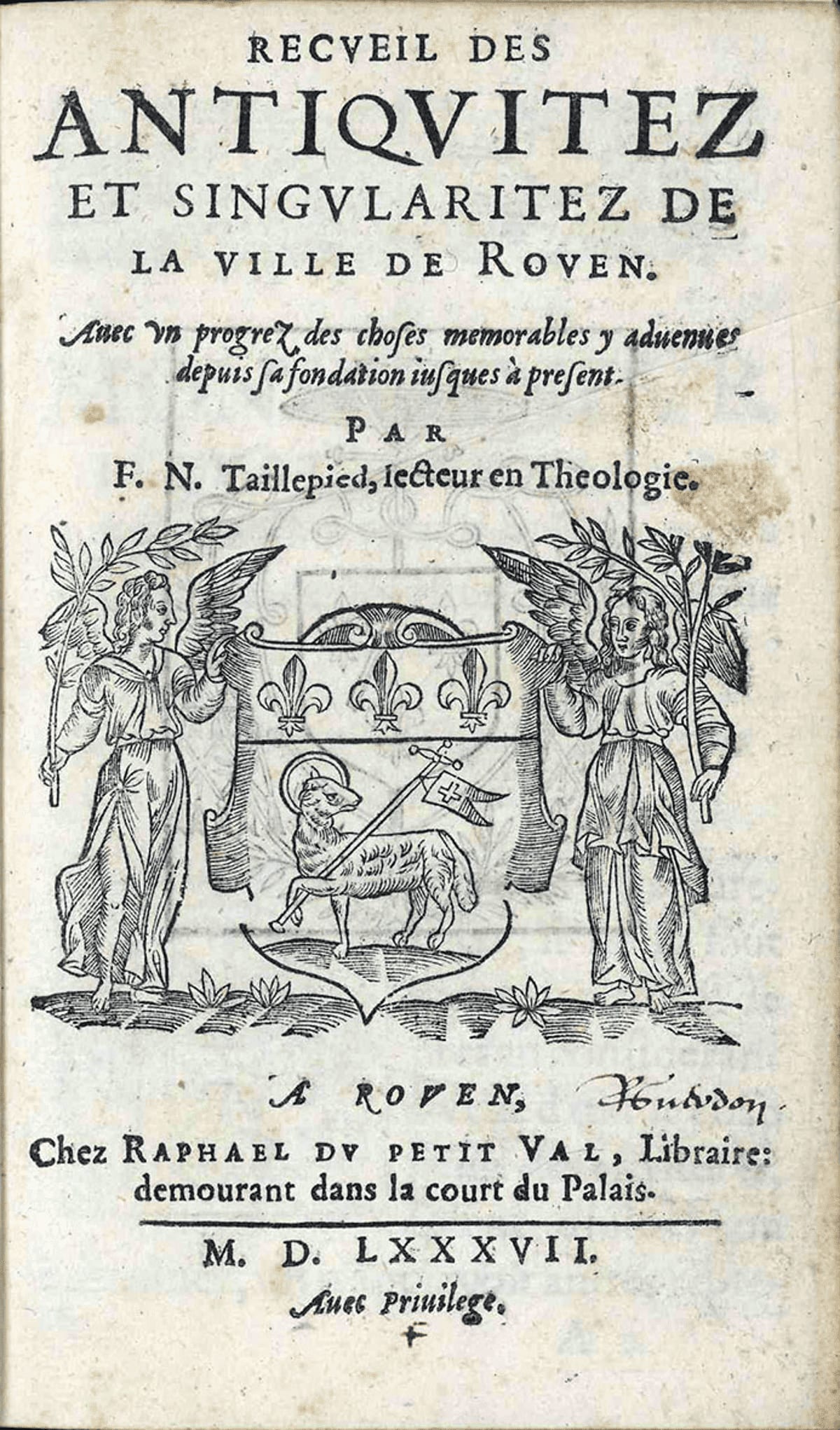
Taillepied’s historical and antiquarian works reflect the late sixteenth-century French fascination with national origins and regional identities. In 1585, he published his landmark treatise Histoire des anciens Druides, contenans leurs moeurs, religion, ceremonies, police, et gouvernement (Paris: René Stephenson), which represents one of the earliest early modern monographs exclusively devoted to the Druids of ancient Gaul. Drawing upon classical ethnographies from Julius Caesar, Pliny the Elder, Strabo, and Tacitus, Taillepied attempted to reconstruct the sacred hierarchies, political structures, and moral philosophy of the pre-Christian Celts. Rather than viewing Celtic polytheism as merely pagan error, Taillepied interpreted Druidical monotheism and their beliefs in the immortality of the soul as a providential proto-Christian foundation inherent to the French soil. He followed this success with major regional chorographies, most notably the Recueil des antiquitez et singularitez de la ville de Rouen (1587) and Les Antiquitez et singularitez des plus celebres villes, bourgs et places remarquables du royaume de France (1586). These texts provided meticulous architectural, ecclesiastical, and institutional histories of Norman and French municipalities, functioning both as civic records and as ideological defenses of sacred spaces threatened by Protestant iconoclasm.
It was in the realm of pneumatology and demonology, however, that Taillepied achieved his most enduring European reputation. In 1588, amidst the apocalyptic tension of the Catholic League's domination of Paris, he published his famous treatise: Psichologie, ou Traicté de l'apparition des esprits, a sçavoir des ames separées, phantosmes, demons et esprits pernicieux, qui se monstrent visiblement aux hommes. Responding directly to Protestant theologians like John Calvin and Pierre Viret—who rejected the doctrine of Purgatory and claimed that ghost apparitions were either fraudulent deceptions or direct manifestations of the Devil—Taillepied constructed a rigorous theological taxonomy of spectral phenomena. Dividing apparitions into divine messengers (angels), saved souls undergoing purgatorial purification, damned spirits, and deceptive demons, he insisted upon the objective reality of post-mortem ghostly visits as divinely sanctioned warnings to the living. His analysis incorporated empirical accounts of local hauntings alongside patristic authority and Aristotelian-Thomistic psychology, offering practical criteria for the discretio spirituum (discernment of spirits) to help confessors distinguish benign purgatorial souls from demonic illusions.
The print history of Taillepied’s works offers a vital window into the publishing strategies of the Counter-Reformation. His major texts were issued by prominent Parisian and Norman booksellers—including Guillaume Bichon, René Stephenson, and Martin Le Mégissier—who were intimately aligned with the radical Catholic printer networks of the League. By choosing to write predominantly in French rather than scholarly Latin, Taillepied democratized theological and antiquarian knowledge, explicitly targeting educated lay magistrates, bourgeois readers, and local clergy. His Psichologie achieved immediate commercial success, undergoing multiple printings in Paris and Rouen before being disseminated across Catholic Europe. In the early twentieth century, the text gained renewed attention in the English-speaking world through Montague Summers’s 1927 translation, titled A Treatise of Ghosts.
Taillepied died in late 1589, likely in Angers or Paris, during the height of the military and political crisis following the assassination of King Henry III. His intellectual legacy endured throughout the seventeenth century, directly influencing subsequent demonological and legal treatises by writers such as Pierre de Lancre, Henri Boguet, and François Garasse. Modern historiography, led by scholars of early modern mentalités, spiritual history, and Celticism, recognizes Noël Taillepied as a foundational figure who synthesized medieval scholastic demonology with Renaissance antiquarianism, crafting a distinctive Catholic defense of the supernatural on the eve of the Enlightenment.
menu_bookBibliography
Niceron, Jean-Pierre. Mémoires pour servir à l'histoire des hommes illustres dans la république des lettres avec un catalogue raisonné de leurs ouvrages. Vol. 39. Paris: Chez Briasson, 1738, pp. 312–318.
Goujet, Claude-Pierre. Bibliothèque françoise, ou Histoire de la littérature françoise. Vol. 14. Paris: H.L. Guerin & L.F. Delatour, 1752, pp. 245–251.
Frère, Édouard. Manuel du bibliographe normand, ou Dictionnaire bibliographique et historique. Vol. 2. Rouen: A. Le Brument, 1860, pp. 542–544.
Summers, Montague. "Introduction." In A Treatise of Ghosts by Noel Taillepied, translated by Montague Summers, v–xix. London: The Fortune Press, 1927.
Ceyssens, Lucien. "Taillepied (Noël)." In Dictionnaire de Théologie Catholique, Vol. 15, Part 1, edited by A. Vacant, E. Mangenot, and É. Amann, 34–36. Paris: Letouzey et Ané, 1946.
Secret, François. "Pneumatologie et eschatologie chez Noël Taillepied." Bibliothèque d'Humanisme et Renaissance 34, no. 2 (1972): 289–301.
Ferlampin-Acher, Christine. "Entre magie, démonologie et merveilleux: La Psichologie de Noël Taillepied (1588)." Revue des Sciences Humaines 240 (1995): 77–96.
Dubost, Jean-François. "Noël Taillepied et l'histoire des Druides au XVIe siècle." Annales de Bretagne et des Pays de l'Ouest 104, no. 3 (1997): 45–61.
Davies, Owen. Ghosts: A Social History (1500–1900). Oxford: Oxford University Press, 2007, pp. 88–104.
Cameron, Euan. Enchanted Europe: Superstition, Reason, and Religion, 1250–1750. Oxford: Oxford University Press, 2010, pp. 215–230.
Machielsen, Jan. "Apparitions, Souls, and Demons: Noël Taillepied and the Franciscan Counter-Reformation." Journal of Early Modern History 18, no. 4 (2014): 355–381.
The biographies and bibliographies on this page are curated by Abu, the new AI scholar exclusively developed for Govi Rare Books.