




German Sammleband containing censored and expurged texts probably bound together to cover up other more sensitive texts, particularly Camerarius’ lenghty prologue against witchcraft and Acronius’ treatise on miraculous phenomena.
Basel-Leipzig, 1536-1621
menu_bookDescription
The miscellany contains six works, five from the 16th century (but one is just a fragment) and one from the beginning of the 17th century:
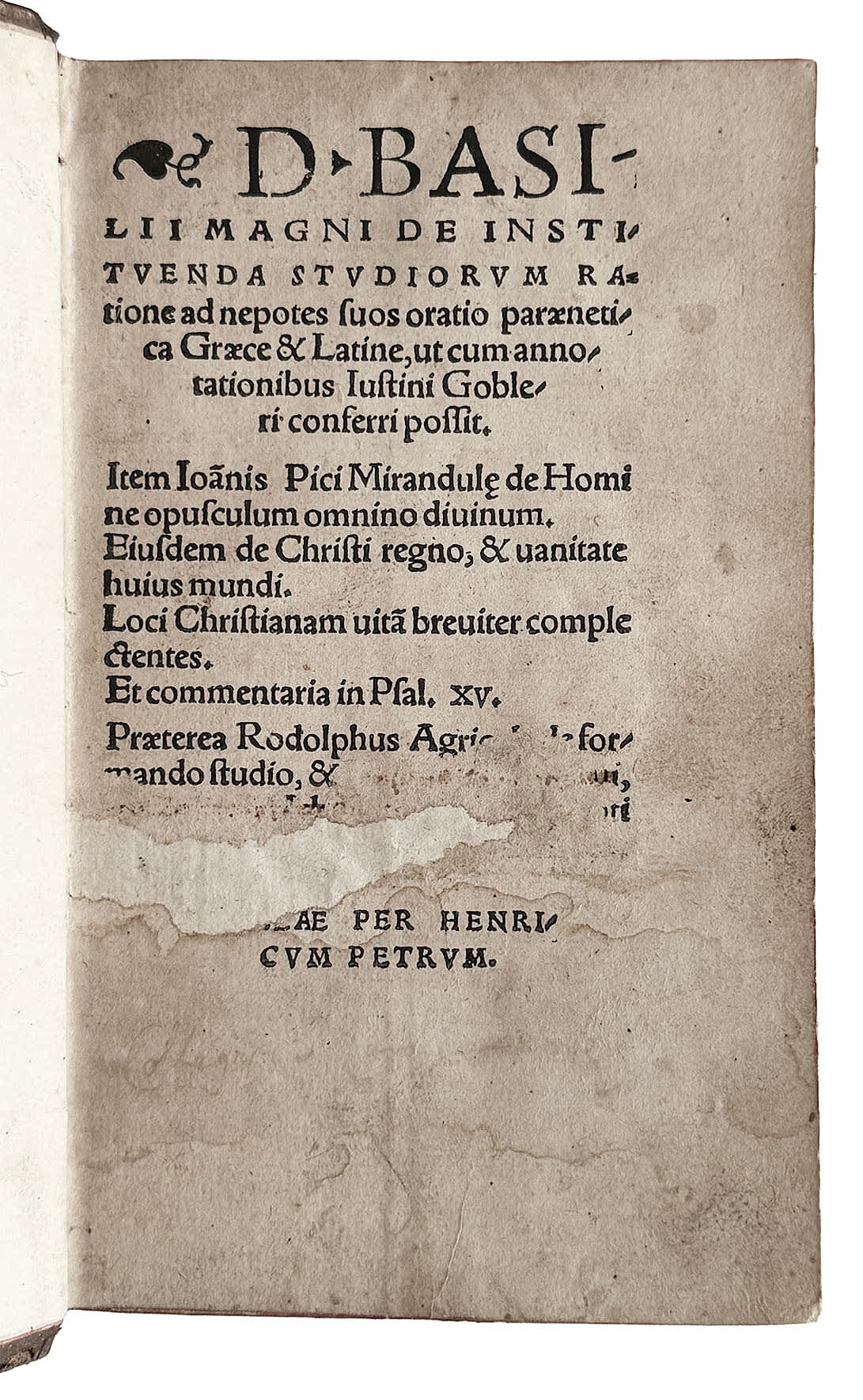
BASILIUS CAESARIENSIS Sanctus (330-379) et al. D. Basilij Magni De instituenda studiorum ratione ad nepotes suos oratio paraenetica Graece & Latine, ut cum annotationibus Iustini Gobleri conferri possit. Item Ioannis Pici Mirandulę De homine opusculum omnino diuinum. Eiusdem De Christi regno, & vanitate huius mundi. Loci christianam uitam breuiter complectens. Et Commentaria in Psal. 15. Præterea Rodolphus Agricola De Formando studio, & Erasmi Roterodami ac Philippi Melanchtonis studiorum rationes, atque locorum communium index. Basel, Heinrich Petri, (1537). [16], 229 [of 262] pp. Also lacking the final leaf with the printer’s device. Collation: a8 A-Q8 R4. Over 30 pages (half quire P to R) at the end, containing the Ratio colligendi exempla, the famous method theorized by Erasmus of Rotterdam in his rhetorical-pedagogical treatise De duplici copia verborum ac rerum (1512), have been expunged. Other signs of censorship such as this are also visible on the title page and on l. P3r, where Erasmus’ name has been erased. Additionally, on leaf P4v, the beginning of Erasmus’s aforementioned treatise is covered by a blank leaf and some scribbles. Leaf N8v is also covered by blank paper strips to censor a brief text by Melanchthon and Erasmus. Some old manuscript annotations, partly trimmed by the bookbinder. Woodcut decorative initials. Roman and Greek types. Curiously, and in apparent contradiction with the aformentioned censorships, the owner of the present Sammelband bound between the title page and leaf a2 a dedication that Melanchthon addressed to his friend and fellow scholar Simon Grynaeus taken from Peuerbach’s Theoricae novae planetarum in the Wittenberg 1551 edition printed by Hans Lufft with a preface by Melanchthon (cf. VD16, P-2061).
Saint Basil the Great’s famous homily, De instituenda studiorum ratione ad nepotes suos oratio paraenetica, printed here also in its original Greek text, was a cornerstone of Christian humanism, as Saint Basil argues that young Christians should actively study pagan classical texts (like Homer and Plato) for their moral virtues, using them as a preparatory stepping stone before diving into Holy Scripture. This specific edition is accompanied by the annotations of the German jurist and humanist Justin Gobler, providing contemporary readers with philological and practical insights into Basil’s rhetoric.
The edition also includes two works by Giovanni Pico della Mirandola, his celebrated Oration on the Dignity of Man and a lesser-known text De Christi regno, & vanitate huius mundi, a sort of commentary on Psalm 15, as well as Rudolph Agricola’s De Formando studio. As said, the final texts by Erasmus and Melanchthon were expurgated by the owner of the volume.
VD16, B-650.
OLYMPIODORUS (fl. 6th cent.). Olympiodori Doctissima in Ecclesiast. scholia, nova & latinis auribus insueta tralatione inserta, Aquilae videlicet, Theodotionis, & 70. Zenobio Acciaiolo Florentino interprete. Divi Gregorij Neocaesariensis In eundem metaphrasis, uel ut Suidæ placet, […] Ioanne Oecolampadio interprete. Aristeae De 72. legis Hebraicæ interpretatione libellus, […] Matthia Palmerio Vicentino interprete. Basel, Johann Bebel, 1536. 8vo. [8], 248 pp. Collation: α4 a-p8 q4. Printer’s device on l. o8v.
These are the commentaries (scholia) attributed to Olympiodorus the Deacon (not to be confused with the Neoplatonic philosopher of the same name), which contain some of the the most ancient lost Greek translations (“unusual to Latin ears”): those of Aquila of Sinope, of Theodotion, and the Septuagint. The translator from Greek to Latin is the Florentine humanist Zenobio Acciaioli (1461-1519), a Dominican friar and prefect of the Vatican Apostolic Library, who rediscovered and translated this commentaries precisely to make fragments of the first Greek biblical translations available to scholars. The second part contains the paraphrase (metaphrasis) of Ecclesiastes written by Saint Gregory Thaumaturgus (or of Neocaesarea), a third-century Church Father. The title cites the Byzantine encyclopedia Suidas for the attribution of the text. The Latin translation here is by Johannes Oecolampadius (1482-1531), a renowned German humanist, Hebraist, and leader of the Protestant Reformation in Basel. The final section is the celebrated Letter of Aristeas to Philocrates, a seminal Hellenistic text that recounts the legendary story of the birth of the Septuagint Bible. The Latin translation is by the humanist Matteo Palmieri (1423-1483).
VD16, O-727.
ATHENAGORAS ATHENIENSIS (ca. 2nd cent.)-AENEAS GAZAEUS (430-486). Athenagoras De mortuorum resurrectione, Petro Nannio interprete [followed by:] Aeneas Gazaeus De immortalitate animarum, et corporum resurrectione, Ioanne Vuolphio interprete. A fragment from Philo Alexandrinus’ (25-40) Lucubrationes quotquot […] Latinae factae per Sigismundum Gelenium (Basel, Nikolaus Episcopius d.J., 1558). 8vo. 1401-1526, [2 blank] pp. Collation: RR-Aaa8.
Athenagoras was one of the most refined Christian philosophers and apologists of the second century. His treatise on the resurrection of the dead is a fusion of Christian theology and Platonic and Aristotelian logic. Rather than relying solely on Scripture, Athenagoras uses pure philosophical argument to demonstrate that the resurrection of the body is logical and morally necessary for the final judgment of humanity. The Latin version is the work of the Flemish humanist Pieter Nanninck (Petrus Nannius, 1500-1557), a highly esteemed professor of Latin at the prestigious Collegium Trilingue in Louvain.
Aeneas of Gaza was a Neoplatonic philosopher who converted to Christianity and lived between the fifth and sixth centuries. His work is structured like a Platonic dialogue: in it, Aeneas refutes traditional Neoplatonic doctrines that viewed the body as a prison of the soul to be destroyed, philosophically arguing for the immortality of the soul and the glorification and final resurrection of the material body. The translation from Greek and the philological restoration of the text are due to Johann Wolf (Ioannes Vuolphius, 1521-1571), a theologian and professor in Zurich.
VD16, ZV-12449.
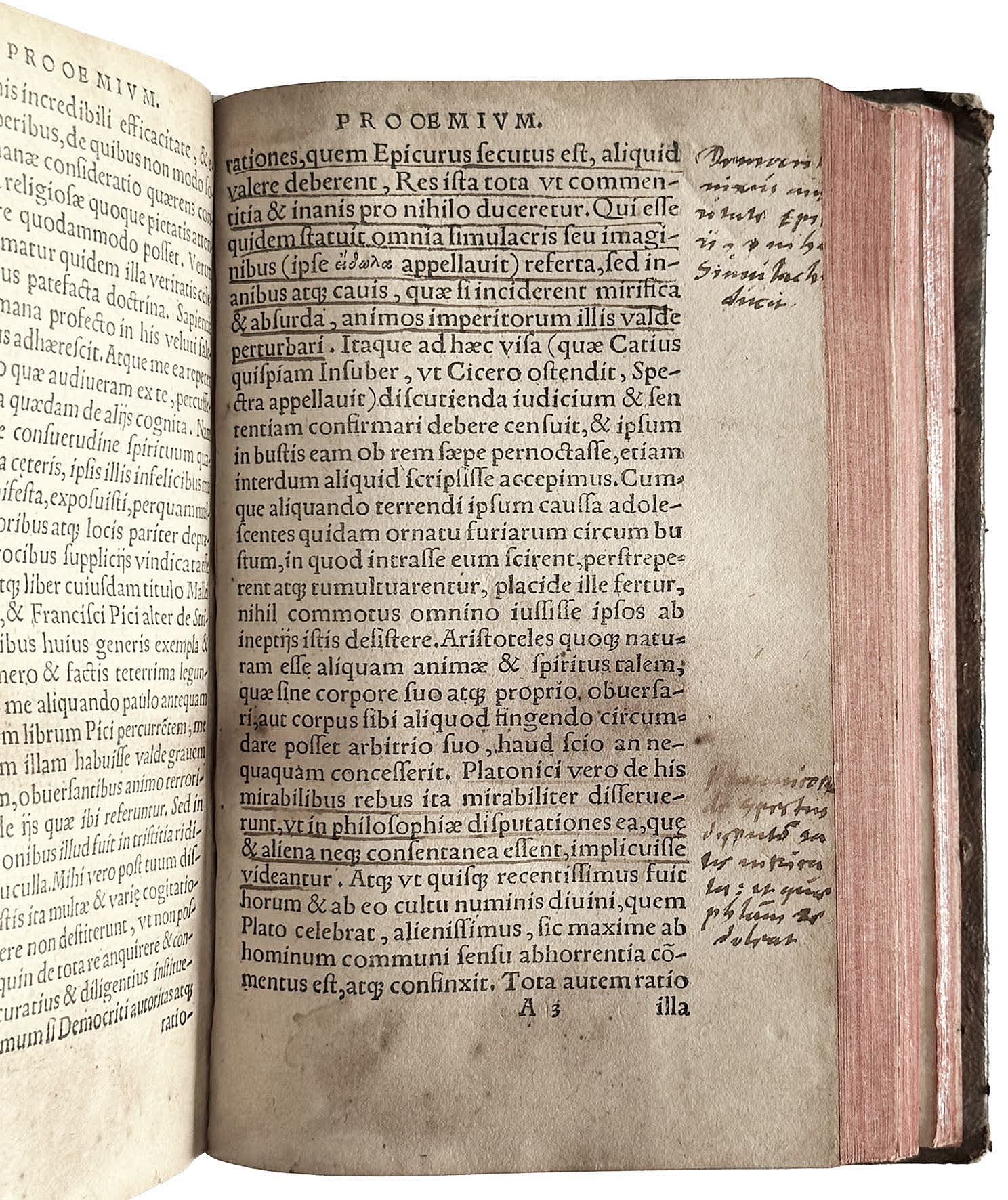
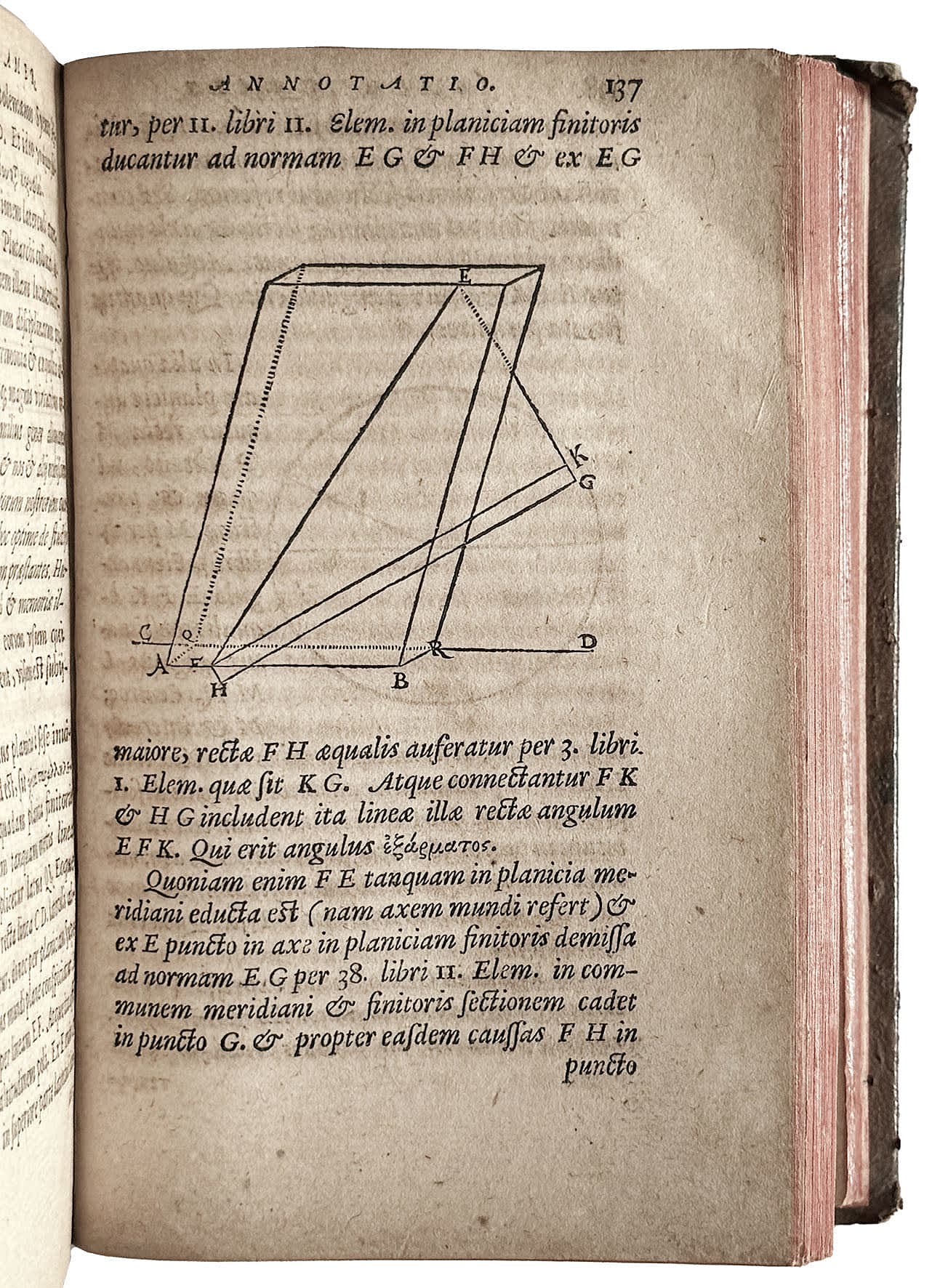
PLUTARCHUS (45-120)-CAMERARIUS, Joachim, ed. (1500-1574). De natura et effectionibus daemonum libelli duo Plutarchi Cheronensis, cum explicationibus, & proemio Ioachimi Camer. Quibus & eruditae, & rarae & iucundae & non inutiles cognitu rerum mirabilium & singularium expositiones continentur. Leipzig, Ernst Vögelin, [1565]. 8vo. [54], 151 [i.e. 152], [2: errata] pp. Collation: A-N8. Woodcut historiated initials and woodcut geometric figures in the text. Inked marginalia and underlinings in later hand (partly trimmed).
Extremely rare first edition (reprinted by Vögelin in 1576). The book combines the text of Plutarch, translated in Latin by Adrien Turnèbe (1512-1565), with the commentary of the German humanist Joachim Camerarius (1500-1574). Plutarch, who was a priest at the Oracle of Delphi, explores in these pages the nature of the “daimones”, understood in Greek culture as intermediary entities between gods and men, responsible for prophetic inspiration. Plutarch’s two works on oracles and prophecy cover a wide range of topics, including spirits, demons, witchcraft, astronomy, and geometry.
Camerarius’s lenghty preface, followed at the end by another long text, which features geometrical figures, called Annotatio, is significant because it not only comments on Plutarch’s text on oracles and prophecy (De Defuctu Oraculorum and De Figura ei, consecrata Delphis), but extends the discussion to contemporary concerns about witches.
“Joachim Camerarius the Elder is routinely praised for his critical acumen in editing classical texts. In this paper I would like to blame him for his role in fostering the witch craze that swept southern Germany a decade after his death. The fifty years between 1581 and 1631 saw the arrest, trial, and execution of some 2,500 witches in Trier, Bamberg, and Würzburg. Although Camerarius is not associated with those trials, I would like to suggest he be held responsible for helping create the intellectual climate that made them possible.
We all go crazy sometimes. Late at night, a sudden noise can set your mind whirring or make you freak out. When that happens, it isn’t always easy to get a grip on yourself and realize that your thoughts are running wild. That happened to Joachim Camerarius one night and it changed his life. He tells us so in the preface to a book he published in Leipzig in or around 1568. The book is a Latin translation of two mystical essays by Plutarch, On the Failure of Oracles and On the E at Delphi, but the surprising thing about it is the title Camerarius gave it: De natura et effectionibus daemonum, ‘On the Nature and Activities of Demons’.
The preface takes the form of a letter from Camerarius to a friend, named Adrianus Albinus, who had stopped twice to visit him in Leipzig while on his way to and from Speyer: It is 51 pages long. In it Camerarius says the conversations they had had led him to stay up late one night reading a book, a book that made him rethink everything he thought he knew. In the pages that follow he proceeds to lay out his revised thoughts about the reality of demons, of witches, and of witchcraft. At length he states his new view to Albinus (p. 28):
Neque est res ista nova, sed priscis quoque temporibus nota atque usurpata. Nomina tantum et voces mutantur, caetera sunt cadem.
That thing you mentioned? It’s nothing new. People knew about it and did it in anti-quity. It’s all the same; only the names have changed.
As becomes clear, the meaning of ista res, ‘that thing you mentioned’, is sexual intercourse. Camerarius and Albinus had talked about sex, but not of the typical kind. Rather, the great scholar and his friend had heatedly debated the reality of sexual intercourse between human beings and demons. From the letter it is obvious that Camerarius was already a true believer in ghosts, mediums, and conjuring the dead, but that is nothing unusual for a man of his times. What is unusual, and bizarre, is his newfound conviction that women literally have sex with demons […]
An incidental clue allows us to fix the date of the letter. On p. 52 Camerarius remarks that 48 years have passed since he last studied with Richard Croke (1489-1558), a teacher with whom he first read bits of Plutarch. That was in 1517, so Camerarius wrote the letter to Albinus in 1565. As we will see, this is precisely the date to which external indications also point.
The letter begins with a convoluted and cryptic sentence (p. 4 = A2r):
Cum nuper hac ex Nemetum urbe revertens transires, et me, perpetua consuetudine tua, humanissime salutasses, recordari te puto, Adriane Albine, factae mentionis inter alios sermones nostros, cuiusdam a me, de mirabilibus cogitationibus meis, quibus causam dedissent narrationes tuae superiorum dierum, quando proficiscens ad Rhe-num huc veneras.
I bet you remember, Adrianus Albinus, that when you passed through here not long ago on your way back from Speyer and (as kindly as ever) you came to see me, I mentioned, among other things, some strange thoughts I'd been having. They were prompted by what you told me about some recent events (narrationes superiorum dierum) when you stopped here on your way to the Rhine.
These ideas certainly could have been stated more clearly. Working backward in time, the sentence says that on a recent trip, Albinus had stopped in Leipzig to see Camerarius, not once but twice. The first time was on his way to Speyer and the second was on his way back. On his first stop, Albinus had told Camerarius about some recent events that set his mind thinking. Camerarius was still brooding on them when Albinus stopped again on his way home, so they discussed them a second time. And after Albinus left again, Camerarius still couldn’t stop thinking about them […] Camerarius goes on (p. 5 = A2v):
Extatque liber cuiusdam titulo Mallei maleficarum, et Francisci Pici alter de Strigibus, in quibus huius generis exempla et plurima numero et factis teterrima leguntur. Atque ego me aliquando paulo antequam cubitum irem librum Pici percurrentem, memini noctem illam habuisse valde gravem ac difficilem, obversantibus animo terroribus variis de is quae ibi referuntur.
There’s a book out there called Malleus Maleficarum (‘A Mallet for Malefactresses’), and another one by Francisco Pico about witches (strigibus). We see case after case like that - really shocking stuff! - in them. I remember leafing through Pico's book that night just before going to bed and having an awful, simply horrible, night. My mind was haunted by all kinds of frightening thoughts about the stuff in that book.
He adds (ibid.):
Mihi vero post tuum discessum de istis ita multae et variae cogitationes obstrepere non destiterunt, ut non possem facere quin de tota re anquirere et considerare accu-ratius et diligentius instituerem.
After you left, I was obsessed by all kinds of thoughts about what you said, and I couldn’t help it: I just had to investigate the whole thing, had to take a really good, hard look at it.
‘The whole thing’ (tota re) turns out to mean not only sex with demons, but demonology as a whole. In the 50 pages that follow Camerarius ransacks classical pagan literature for evidence of the existence and harmful activity of demons, ghosts, nightmares, madness, visions, magic cures, and witches. He conflates fact and fiction; he cites hearsay evidence and stories of evildoing to which no names or dates are attached. Remarkably, he chooses not to invoke his Christian faith for his belief in witches, preferring instead the evidence of classical authors. Fifty pages later, he has concluded that witches are real and that this was a fact known to all ancient authorities. He also concludes that witches celebrate orgies and do have sexual intercourse with demons. Although that was an old rumor in Catholic countries, it was something new in Germany, especially Protestant Germany; I will come back to this point. Camerarius goes on at such length not out of prurience or misogyny but because he is plainly trying to prove to himself that demons (or rather, daimones - meaning both good spirits, like angels, and evil spirits) are corporeal […]
When he published it, Camerarius was hailed as the leading light in Europe and the successor of Erasmus. On the last page of the letter, he addresses Albinus once more and makes two important points. First, he reveals why he wrote the letter (p. 51):
Tuae, Albine Adriane, narrationes illas cogitationes, quas exposui, commoverunt, casque ut scripto completerer, ne quasi evanescerent, cum alia me impulerunt, tum quod eas ipsas abs te legendo cognosci cuperem.
All these thoughts of mine were prompted by what you told me, Adrianus Albinus, and that induced me to write them down, not just to ensure they wouldn’t vanish (so to speak when I became preoccupied with other matters, but also because I wanted you to read and learn from them).
He then offers a prediction about the fate of these efforts (p. 53 = p. D2v):
Quod autem ad rem ipsam attinet, habes, Adriane Albine, meam sententiam de iis, quae et tractata sunt sermonibus nostris te praesente, et his Plutarchi libellis dis-putantur, habes operam quoque interpretationis. [..] alios, si qui illa forte legerint eruditi et docti, confido studium diligentiae meae non esse improbaturos.
And there you have it, Adrianus Albinus - my thoughts on what you and I talked about when you were here, matters that these essays of Plutarch’s also discuss. You’ve also got my best shot at making sense of them. [...] If any other sophisticated readers come across them, I’m positive they won't criticize the careful attention I gave them.
It isn’t clear in that last sentence whether Camerarius is referring to his thoughts on demonology or to the annotations he adds to the translations of Plutarch; but at any rate, Camerarius’ Plutarch book was reprinted in Leipzig in 1576, two years after his death. Five years later, in 1581, and closer to Würzburg, the preface was reprinted in Frankfurt am Main. It appeared as a supplement to the Flagellum haereticorum fascinariorum (‘A Scourge for Heretical Witches’), an inquisitor’s treatise that asserted the equivalence of heretics and witches. Two years after that, the flames of a thousand bonfires began to light up the heavens in Trier. The Great Witch Craze had come to southern Germany.
Camerarius’ addressee is not a famous man. Who was Adrianus Albinus, and what did he tell his friend to shock him so? Born in Lauban, Silesia (today Lubań, in southwest Poland), Adriarius Albinus (1513-1590) studied law in Poland, Germany, France, and Italy. In 1541, at the age of 28, he briefly taught law in Leipzig. There he probably met Camerarius, who arrived the same year as Professor of Latin and Greek. In 1544 Albinus became Professor of Roman Law at the University of Frankfurt-Oder, in Brandenburg, and the year after that, in 1545, the 32-year old Albinus was named the Chancellor of Neumark (cancellarius Neomarchiae) and legal advisor (consiliarius, Rat) to John, Margrave of Brandenburg-Küstrin" (1513-1571). Thirty-five years later, in 1590, Albinus died and was buried in Küstrin. A contemporary obituary says he had been a devout Christian and lifelong devotee of Plutarch’s Parallel Lives.!? The Plutarch connection could explain why Camerarius dedicated the book to him, but probably not. That brings me to the topic of their conversation, and in particular the narrationes superiorum dierum, as Camerarius called them (pp. 4-5 = A2t-A2v):
Commemoravisti enim tunc, quid apud vos compertum prolatumque fuisset, de mulie-rum quarundam veneficarum horribilibus facinoribus, deque superstitionis incredibili efficacitate, et eiusmodi operibus, de quibus non modo sollertiae humanae consideratio quaerens conturbari, sed religiosae quoque pietatis attentio vacillare quoddamodo posset. [..] Atque me ea repetentem animo quae audiveram ex te, percusserunt similia quaedam de aliis cognita. Nam quod tu de consuetudine spirituum quadam occulta ceteris, ipsis illis infelicibus mulieribus manifesta, exposuisti, perquam multa altis temporibus atque locis pariter depraehensa, et atrocibus suppliciis vindicata esse constat.
You see, when we spoke you mentioned what an inquiry back home (apud vos) had discovered (compertum) and brought to light about the awful crimes of some poisoner-women (veneficae) and the incredible power of superstition and workings of that sort. As you put it, looking into those things doesn’t just befuddle a clever man’s reason; it can even shake firm religious faith. […] And while I kept brooding on what you told me, I was struck by some legal discoveries about other women (de altis cognita) that resemble the ones you were talking about. You see, what you said - about a certain ‘sexual intercourse with spirits’ that those terrible women themselves can see but nobody else can - well, it’s a fact that lots and lots of cases were detected and punished by dire penalties at other times and places.
Camerarius next mentions the awful night he stayed up reading Pico’s book. Since he blames that incident for converting his worldview from skepticism to belief, whatever Albinus told him must have been grave indeed. After some sleuthing, I think I have figured out what it was. The facts are as follows.
Mark Brandenburg, where Albinus was from, was one of the earliest regions in central Europe to prosecute and execute witches. Witch trials elsewhere in Germany only began in earnest around 1570, but in Brandenburg the trials peaked before 1580. In its northwest there is a district called Prignitz. Its capital is a small city called Perleberg, whose population before the Thirty Years’ War (1618-1648) was about 3,000. That is where, in 1565, all hell broke loose - literally. In two waves, small groups of women were tried, convicted, and speedily executed for the crime of sorcery. Though he says nothing of the details, Gerhard Schormann considers the second of these trials a watershed: ‘1565 marks the first time’, he observes, ‘that five women were convicted at one trial and with it, the first appearance of witch lore, including Walpurgis Night on the Blocksberg’.
It all happened so fast. Four days after Walpurgis Night in 1565 (the night between April 30 and May 1), three women of Perleberg were arrested, interrogated, convicted, and executed for sorcery. A week later five more witches were caught and tried and, like the first, met their fiery fate on the Weinberg hillside in Perleberg. The witches had been accused of poisoning, but […] the Perleberg women [also] admitted to celebrating a witches’ sabbat, just days before their arrest, on the Blocksberg. This was an unprecedented admission in Christian Germany […] The fate of these latter four women is not clear, but in just one week's time, at least eight and perhaps twelve witches were caught, tried and burned in one small city.
Those confessions, certified by execution, must have sparked fears that an evil conspiracy was afoot. This was the moral panic Albinus told Camerarius of […] The Perleberg trials took place in Altmark, in West Brandenburg. Although Adrianus Albinus lived in Neumark, in East Brandenburg, he certainly knew about them. As chancellor of Neumark he would not have been a member of the Appeals Panel, but he was well aware of its activities […] [All this brings to the probable conclusion] that it was this spate of witch trials in Perleberg in 1565 that Albinus told Camerarius about during his two stops in Leipzig […] It is clear from the letter that Camerarius had already believed in demons and, presumably, witchcraft or harmful magic (maleficium) - poisoning, uttering oaths, casting spells, and other physical interventions - long before Albinus arrived. His revelation, therefore, was the sudden realization that the witches’ sabbat, replete with lurid demon sex, was real and was being celebrated right there in Germany. The Perleberg confessions, and executions, had just proven it […]
By 1580, six years after Camerarius’ death, belief that a witches’ sabbat was celebrated on the Blocksberg had spread throughout Germany. For example, it is the subject of an anonymous treatise printed in Rostock that year titled Concerning the Witches' sabbat in Brocken Mountain, which is also called Blocksberg Camerarius did not mention the sabbat explicitly in his Plutarch book, but he did discuss sex with demons. So did his book - and its reprints - help promote belief in it? […] He took an existing idea and amplified it, and not only as a radio tower amplifies sound. He also amplified it in stature, adding dignity and authority to a rabble-rousing mistake. His authority authenticated and relayed the idea throughout Germany, where it went viral […] What Camerarius did was worse than authenticating a forgery, like spurious fossils or a Vermeer painting. Camerarius - the university reformer, the ‘eye of Germany,’ the heir of Erasmus - authenticated a mistake. Should we condemn him, and Albinus, for their credulity? […]
Like many of his contemporaries, Camerarius made the fatal leap of faith from physical harm (poisoning: cf. veneficae) and threats of it (invoking the devil) to supernatural crime - the witches’ sabbat. But that is less a giant leap than a small step on the journey […] Well-entrenched ideologies - such as messianic Christianity had been […] - are, of course, not easily refuted. Once the basic premises of an ideology are accepted, new observations are perceived in its imagery and articulated in its vocabulary. The result is that while no fresh observation can undermine the belief system, new ‘facts generated by the ideology constantly lend further support to it. This was true in the past for the belief in witchcraft and the corresponding prevalence of witches […] Camerarius did this. He relied on his well-entrenched ideology to generate new ‘facts’ about witches and the corresponding prevalence of witches, and lent his support to it […] So I would not be too quick to condemn Albinus and Camerarius for their credulity. His decision to get involved - to speak out publicly - is a different matter. If public intellectuals are responsible for their public statements, we must condemn Camerarius for his. He abused classical literature - taking the fictions of Plautus, Ovid, Apuleius, and others as evidence of reality, and, to judge from the reprints of his letter to Albinus, he persuaded others he was right […]
Did Camerarius recant his belief in witchcraft on his deathbed? In Lea [Materials Toward a History of Witchcraft, Philadelphia] 1939, vol. 1, 248 we read:
[…] Camerarius was consulted in 1571 by William IV of Hesse Cassel (son of Philip the Magnanimous) [1532-1592] about some women arrested for jugglers’ [i.e. swindlers’] tricks on a boy. Camerarius opposed the use of torture in such cases and also the water ordeal which Wilhelm was disposed to employ, as he was sure that they would sink, and warned him against the cruelty of witch-burning and the prosecutions by which the innocent were obliged to confess.
This suggests Camerarius, who died in 1574, repented late in life for the views he expressed in his letter to Albinus a decade earlier. Sadly, it is apocryphal. Lea has mistaken Camerarius the Elder for his son, Joachim Camerarius the Younger (1534-1598), a distinguished physician and naturalist of Nuremberg and a known associate of William’s over many years” (M. Fontaine, Joachim Camerarius on Witches, Witchcraft, and Criminal Responsibility, or, How to Philologize with a Witches’ Hammer, in: “Camerarius Polyhistor”, Th. Baier, ed., Tubingen, 2017, pp. 335-356).
While the second 1576 edition occasionally appears on the market, to find another copy of this first edition on the market, one has to go back to the Sotheby’s New York auction sale of 20 April 1931, when a copy was purchased by McLeish.
VD16, P-3696.
ACRONIUS, Johannes (1520-1564). Miraculorum quorundam et eorundem effectuum descriptio, per Iohannem Acronium Frisium Mathematicum Basiliensem. Basel, Jakob Kündig, 1561. 8vo. [14 of 16], 46, [2] pp. Collation: *8 A-C8. Without the title page, removed probably for security concerns. Woodcut initials and ornaments. Printer’s device on last leaf recto.
Rare first edition. Born in Friesland (in Akkrum, hence the name Frisius) around 1520, Johannes Acronius moved to Basel, where he first obtained a chair in mathematics (1547), then in logic (1549), and finally, in the last year of his life (1564), graduated in medicine before tragically dying of the plague. His Miraculorum quorundam et eorundem effectuum descriptio (‘Description of certain miracles and their effects’) was published in 1561, a period of enormous ferment in pre-Galilean astronomy. As a mathematician and expert in astrolabes, Acronius analyzed the phenomena of the upper atmosphere and outer space, attempting to calculate their physical, mathematical, and meteorological effects on Earth. As was almost always the case in the 16th century, the scientific description of comets and meteors was not entirely unrelated to astrology and historical accounts. The text examines the “effects” of these celestial bodies, which the contemporary mindset still considered indicators or physical messengers of major political changes, famines, or climate changes.
“Die Schrift […] behandelt Meteore, Kometen und andere Himmelserscheinungen und ihre Einflusse auf das irdische Geschehen. Dabei werden sowohl Ereignisse aus friiheren Epochen als auch Beobachtungen von Acronius und seinen Zeitgenossen erwahnt. Acronius vertritt den Standpunkt, daB die Himmelserscheinungen von Gott geschickt wurden, um seine GroBe zu demonstrieren, dem Menschen Zeichen zu geben und gegebenenfalls kunftiges Unheil anzukundigen. Seine Erklarungen iiber Struktur und Aufbau des Himmels und der uberirdischen Korper steht noch in der Tradition des Aristoteles” (‘The text discusses meteors, comets and other celestial phenomena, as well as their impact on events on Earth. It references events from earlier eras, as well as observations made by Acronius and his contemporaries. Acronius believed that celestial phenomena were sent by God to demonstrate His greatness, provide signs to humanity, and foreshadow future calamities when necessary. His explanations of the structure and composition of the heavens and celestial bodies follow the Aristotelian tradition’) (M. Folkerts, Eine Verwechslung mit Folgen: Die Humanisten Acronius und Atrocianus, in: “Sudhoffs Archiv”, vol. 85.1, 2001, p. 59).
VD16, A-135.
COGAMANDOLUS, Theonestus. Secreta Secretorum. Calvino-Turcica Secreta, Eorundemque Apocalypsis. XCIV. Considerationibus Exposita, & futuro Principum Conventui exhibenda. In qua praecipue demonstratur, Calvinistas, Catholicis, Lutheranis, Suis Confoederatis Exitium Molitos. Auctore, Theonesto Cogmandolo […] Acta, & revisa in secretissima Cancellaria Anhaltina omnia, cum originalibus collata, & hac tertia editione aucta. Notulas addidit Nicolaus Herris Ab Isecera, Iprensis, Auctoris discipulus. N.pl., n.pr., 1621. 8vo. 94 [i. e. 88] pp. Collation: A-E8 F4.
One of three editions printed in the same year. Theonestus Cogmandolus, or Cogamandolus, is a pseudonym that has been erroneously identified with Étienne Moquot (1570-1625). The identity Nicolaus Herris ab Isecera, or Herisbarisecera, is also a pseudonym that cannot be identified.
This pamphlet is a Counter-Reformation and anti-Calvinist propaganda pamphlet, most likely published in Germany. The text fits into the tense climate preceding the Thirty Years’ War, aiming to demonize the Calvinist faction in the eyes of European rulers. A text with a similar title and subject matter had already been published in Antwerp in 1597, Calvino-turcismus, id est, calvinisticae perfidae, by the English theologian William Reynolds.
The author accuses the Calvinist Church of having entered into a secret political and ideological alliance with the Ottoman Empire (the Turks), then considered the archenemy of Christianity. The work often circulated anonymously or, as in this case, under the pseudonym Theonesto Cogmandolo.
VD17, 12:108122C.
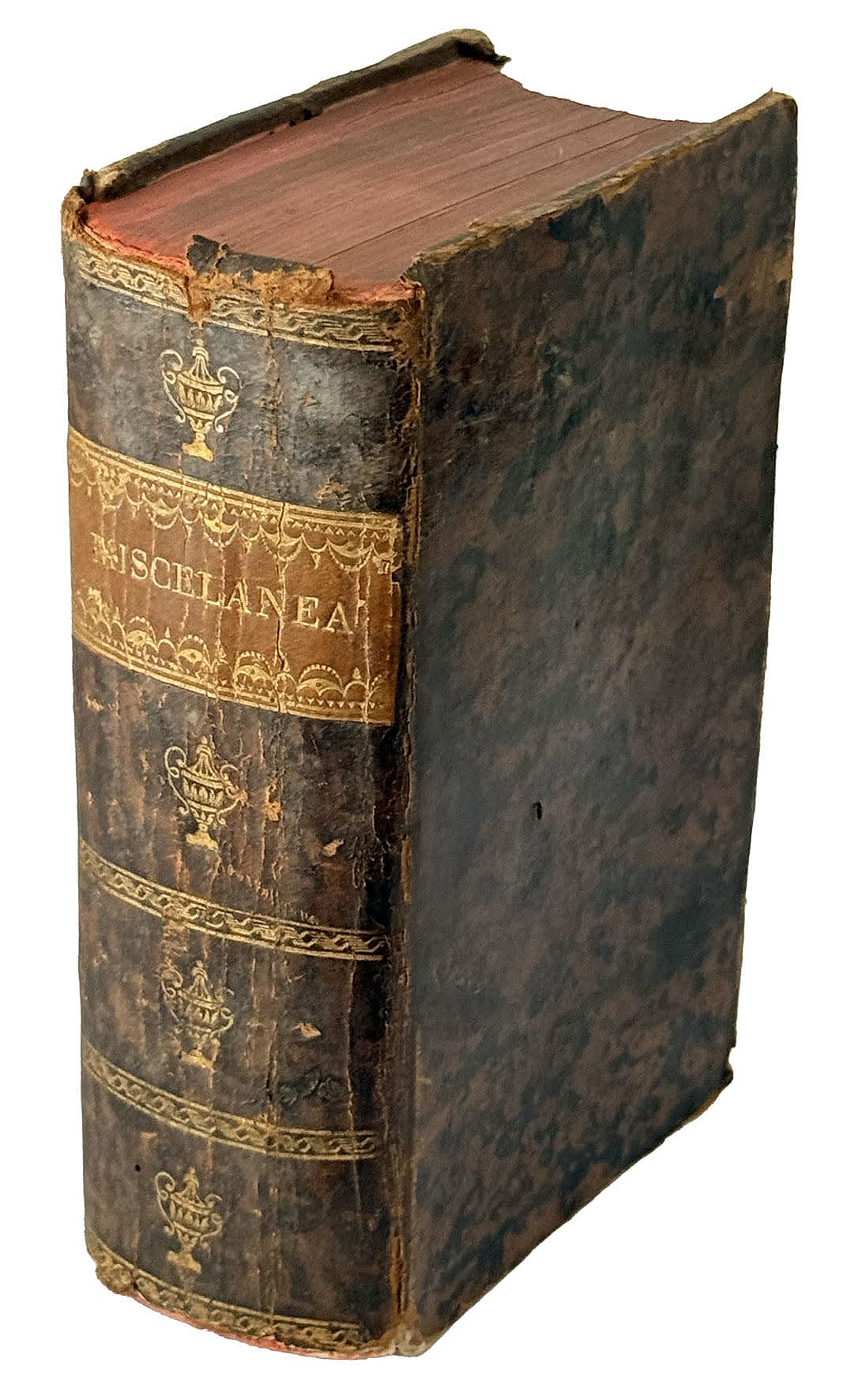
Six works in one volume (154x95 mm). 18th-century full marbled leather (worn at edges and rubbed), gilt spine with morocco lettering piece (“miscellanea”), red edges. Large restoration to the title page of the first work with loss of text, some leaves of the Basilius detached, worm track to the final four leaves slightly affecting the text, browned at places, some occasional staining.
library_booksBibliography
VD16, B-650; VD16, O-727; VD16, ZV-12449; VD16, P-3696; VD16, A-135; VD17, 12:108122C; M. Fontaine, Joachim Camerarius on Witches, Witchcraft, and Criminal Responsibility, or, How to Philologize with a Witches’ Hammer, in: “Camerarius Polyhistor”, Th. Baier, ed., Tubingen, 2017, pp. 335-356; M. Folkerts, Eine Verwechslung mit Folgen: Die Humanisten Acronius und Atrocianus, in: “Sudhoffs Archiv”, vol. 85.1, 2001, p. 59.
personRelated Names
1 / 6
Kündig Jakob
Jakob Kündig (frequently Latinized in imprints as Jacobus Cyndicus or Jacobus Cundisius; active c. 1542–1560) stands as an influential, if frequently understated, figure within the...
Discover profilearrow_forward![Cento novelle scelte da più nobili scrittori della lingua volgare, [...] Nelle quali piacevoli et aspri casi d’amore, et altri...](https://res.cloudinary.com/ozscbgip/image/upload/c_limit,w_2560,f_auto,q_auto:good,e_sharpen:70/v1784284131/govi_stock/govi-sansovino-le-cento-novelle-scelte-1566.jpg)
